
Introduction
Every business registered under the Goods and Services Tax (GST) system in India receives a unique identification number called the GST Identification Number (GSTIN). While many people use this number on invoices, tax returns, and official documents, only a few understand what each character actually represents.
Learning the GST number format is useful for business owners, accountants, students, tax professionals, and even customers who want to verify a registered business. Each character in a GSTIN has a specific meaning, including the state of registration, the taxpayer’s PAN, the registration sequence, and a verification character.
If you’ve searched for GSTIN format, GST number structure, or GST format example, this guide will explain everything in simple language with practical examples.
What is a GST Number?
A GST Number, officially known as the Goods and Services Tax Identification Number (GSTIN), is a unique 15-character alphanumeric identification number assigned to registered taxpayers under the GST system in India.
The GSTIN serves as the official identity of a taxpayer for GST-related activities such as:
- Filing GST returns
- Issuing GST invoices
- Paying GST
- Claiming eligible Input Tax Credit (ITC)
- Verifying registered businesses
- Maintaining GST compliance
The GST registration rules specify that a GSTIN follows a fixed structure consisting of a state code, PAN, entity code, and a checksum character.
What is the GST Number Format?
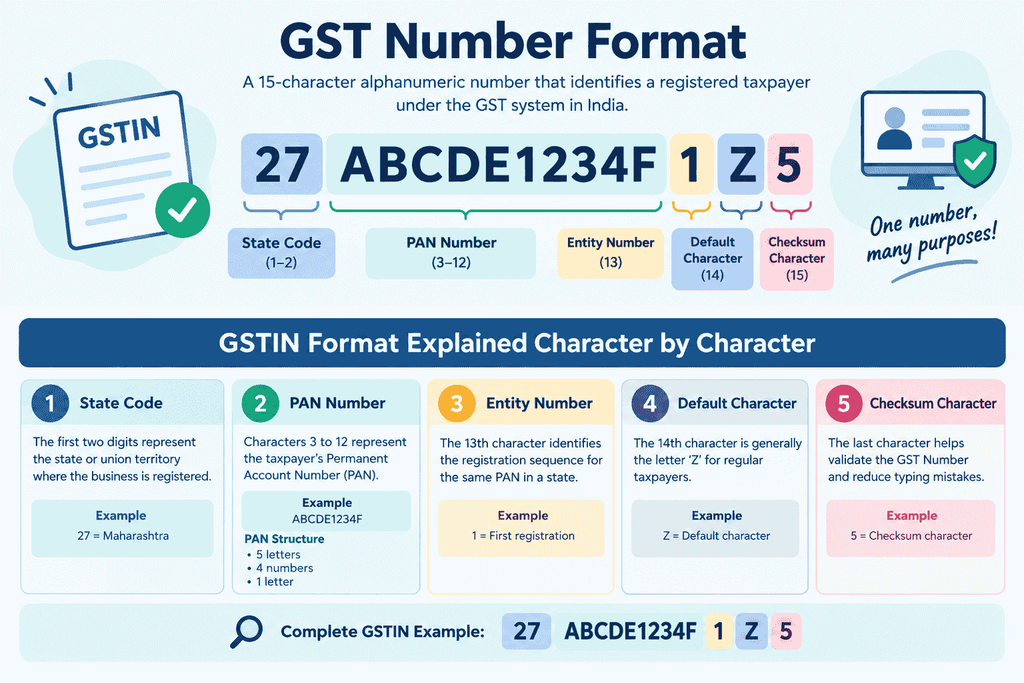
The GST number format consists of 15 alphanumeric characters.
GST Format Example
27ABCDE1234F1Z5
Every character has a specific purpose.
| Character Position | Description |
| 1–2 | State Code |
| 3–12 | PAN Number |
| 13 | Entity Number |
| 14 | Default Character (Usually Z) |
| 15 | Checksum Character |
Understanding this format makes it easier to identify and verify GST numbers.
GSTIN Format Explained Character by Character
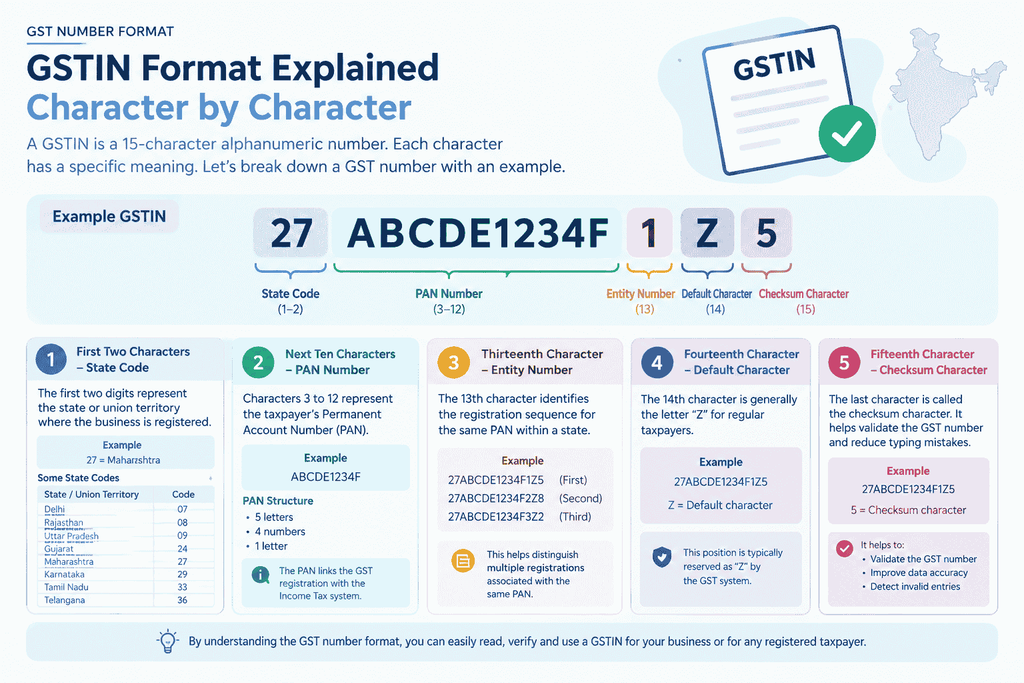
Let’s understand the GSTIN format using an example.
Example GSTIN
27ABCDE1234F1Z5
We’ll break down every part.
Part 1: First Two Characters – State Code
The first two digits represent the State Code where the business is registered.
Every Indian State and Union Territory has its own unique GST code.
Examples
| State | State Code |
| Delhi | 07 |
| Rajasthan | 08 |
| Uttar Pradesh | 09 |
| Gujarat | 24 |
| Maharashtra | 27 |
| Karnataka | 29 |
| Tamil Nadu | 33 |
| Telangana | 36 |
Example
GST Number:
27ABCDE1234F1Z5
Here,
27 = Maharashtra
This indicates that the GST registration belongs to Maharashtra.
Part 2: Next Ten Characters – PAN Number
Characters 3 to 12 represent the taxpayer’s Permanent Account Number (PAN).
Example:
ABCDE1234F
The PAN links GST registration with the Income Tax system.
The PAN itself contains:
- Five letters
- Four numbers
- One letter
Every GST registration is PAN-based, except in certain limited cases provided under GST law.
Part 3: Thirteenth Character – Entity Number
The 13th character identifies the registration sequence for the same PAN within a particular state.
Example
Suppose a company has multiple GST registrations in one state.
Its GST Numbers may appear as:
- 27ABCDE1234F1Z5
- 27ABCDE1234F2Z8
- 27ABCDE1234F3Z2
Here:
- 1 = First registration
- 2 = Second registration
- 3 = Third registration
This helps distinguish multiple registrations associated with the same PAN.
Part 4: Fourteenth Character – Default Character
The 14th character is generally the letter:
Z
For regular taxpayers, this position is typically reserved as “Z” by the GST system.
Example:
27ABCDE1234F1Z5
Here,
Z is the reserved default character.
Part 5: Fifteenth Character – Checksum Character
The last character is called the Checksum Character.
Its purpose is to:
- Help validate the GST Number
- Reduce typing mistakes
- Improve data accuracy
- Detect invalid GSTIN entries
The checksum may be an alphabet or a number generated by the GST system.
Complete GST Number Structure Explained
Let’s decode another GST Number.
GST Format Example
29PQRSX5678L1Z9
| Part | Value | Meaning |
| State Code | 29 | Karnataka |
| PAN | PQRSX5678L | Taxpayer PAN |
| Entity Number | 1 | First Registration |
| Default Character | Z | Reserved Character |
| Checksum | 9 | Verification Character |
Another GST Format Example
Example:
07ABCDE1234F2Z7
Explanation:
- 07 → Delhi
- ABCDE1234F → PAN
- 2 → Second GST Registration
- Z → Default Character
- 7 → Checksum Character
This example illustrates how the GSTIN format remains consistent while certain values vary.
Why is the GST Number Format Important?
Understanding the GST number structure provides several practical benefits.
1. Business Verification
It helps confirm whether a GST Number appears correctly structured before checking its registration status.
2. Better GST Compliance
Knowing the format reduces mistakes when preparing invoices, returns, and other GST documents.
3. Vendor Verification
Businesses can compare GST details with supplier records before making transactions.
4. Error Detection
Understanding the structure makes it easier to identify obvious data-entry errors.
5. Improved Record Keeping
Properly recorded GST Numbers help maintain accurate business documentation.
Common Mistakes While Reading GST Numbers
Many users make simple mistakes while entering or verifying GST Numbers.
Common errors include:
- Using the letter O to confuse the number 0
- Mistaking the letter I for the number 1
- Entering the wrong state code
- Using an incorrect PAN sequence
- Missing the checksum character
- Typing extra or fewer than 15 characters
Always double-check the GST Number before using it on invoices or official records.
How to Verify a GST Number
Before conducting business with a supplier or customer, verify the GST Number.
Verification helps confirm:
- Legal business name
- Trade name
- GST registration status
- State of registration
- Principal place of business
- Registration date
- Taxpayer type
Using verified GST details helps reduce compliance risks.
Difference Between GST Number and PAN
Many beginners think GST Number and PAN are the same.
They are different.
| GST Number | PAN |
| 15 Characters | 10 Characters |
| Used for GST compliance | Used for income tax purposes |
| Includes State Code | No State Code |
| Includes PAN | Standalone tax identification number |
Although the PAN forms part of the GSTIN, both serve different legal purposes.
Benefits of Understanding the GSTIN Format
For Business Owners
- Prepare accurate invoices
- Verify suppliers
- Reduce filing errors
- Maintain compliance
- Improve business credibility
For Accountants
- Validate taxpayer information
- Prepare GST returns accurately
- Reduce reconciliation mistakes
- Maintain organized records
For Customers
- Verify registered businesses
- Confirm invoice details
- Promote transparent transactions
Tips to Remember the GST Number Format
A simple way to remember the format is:
2 + 10 + 1 + 1 + 1 = 15
Where:
- 2 = State Code
- 10 = PAN
- 1 = Entity Number
- 1 = Default Character (usually Z)
- 1 = Checksum Character
This formula makes the structure easy to remember.
Best Practices for Using GST Numbers
Follow these practices to avoid errors:
- Verify GST Numbers before business transactions.
- Use the exact GSTIN on invoices.
- Check the state code carefully.
- Ensure the business name matches the GST registration.
- Keep GST records updated.
- Periodically verify supplier GST details through official government resources.
Frequently Asked Questions (FAQs)
What is the GST number format?
The GST number format is a 15-character alphanumeric structure consisting of a state code, PAN, entity code, a default character (generally “Z”), and a checksum character.
What is GSTIN format?
The GSTIN format follows this structure:
- 2 characters → State Code
- 10 characters → PAN
- 1 character → Entity Number
- 1 character → Default Character (usually Z)
- 1 character → Checksum Character
Why is the letter “Z” used in GSTIN?
For regular GST registrations, the 14th character is generally “Z”, which is reserved by the GST system.
What is the GST number structure?
The GST number structure consists of:
- State Code
- PAN
- Entity Number
- Default Character
- Checksum Character
Together, these make a 15-character GSTIN.
Can one PAN have multiple GST Numbers?
Yes. A business may have multiple GST registrations under the same PAN, depending on the applicable GST provisions, such as registrations in different states or permitted multiple registrations within a state.
How can I verify a GST Number?
You can verify a GST Number through the official GST Portal to confirm the taxpayer’s registration details and status.
Conclusion
Understanding the GST number format is essential for anyone involved in business, accounting, taxation, or financial management. A GSTIN is not a random combination of letters and numbers—each of its 15 characters has a defined purpose, from identifying the state of registration and linking the taxpayer’s PAN to distinguishing multiple registrations and validating the number with a checksum.
By learning the GSTIN format, GST number structure, and reviewing practical GST format examples, you can issue accurate invoices, verify business registrations, reduce compliance errors, and improve record management. Whether you’re a business owner, accountant, student, or consumer, this knowledge helps you interact with the GST system more confidently.