
Introduction
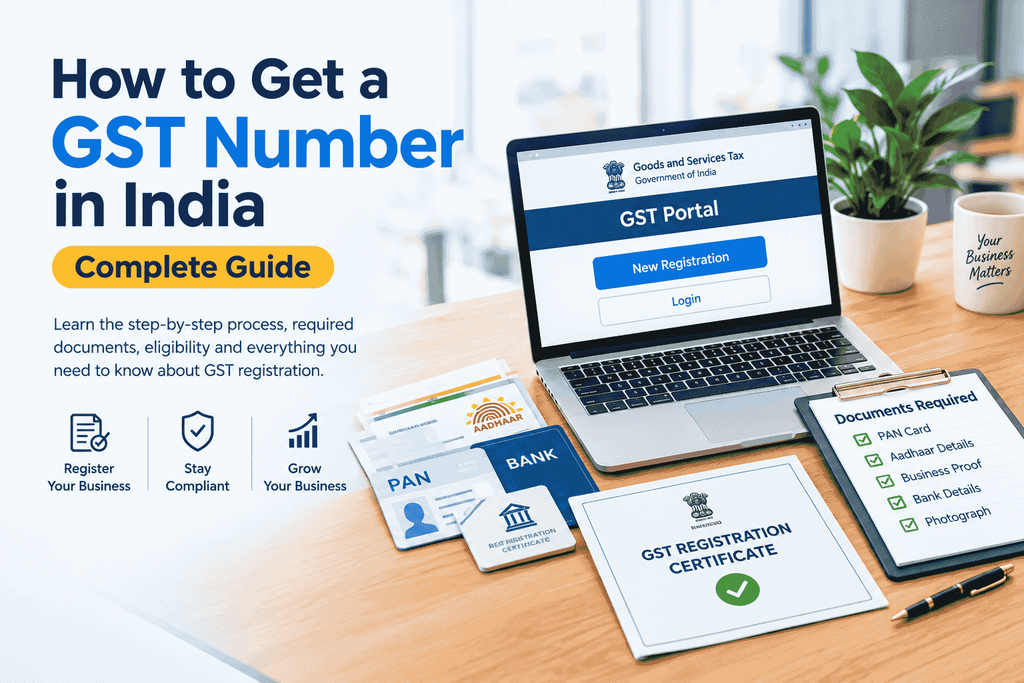
If you’re starting a business, working as a freelancer, opening an online store, or expanding your commercial activities in India, one of the first questions you may have is how to get GST number. A GST Number, officially called the Goods and Services Tax Identification Number (GSTIN), is issued to eligible businesses after successful GST registration.
Businesses that are required to register under the Goods and Services Tax (GST) law must take the crucial step of acquiring a GST Number. It allows eligible taxpayers to issue GST invoices, file GST returns, claim Input Tax Credit (ITC) where applicable, and comply with GST regulations.
In this comprehensive guide, you’ll learn how to get GST number, who needs GST registration, the step-by-step application process, the documents required, common mistakes to avoid, and frequently asked questions.
What is a GST Number?
A GST Number (GSTIN) is a unique 15-character alphanumeric identification number issued to taxpayers registered under India’s GST system.
A GST Number is used for:
- Filing GST returns
- Issuing tax invoices
- Paying GST
- Claiming eligible Input Tax Credit (ITC)
- Verifying business registration
- Conducting GST-compliant business transactions
Every registered taxpayer receives a unique GSTIN after the registration application is approved.
Who Needs GST Registration?
Before learning how to get GST number, it’s important to understand who may need GST registration.
GST registration may be required for:
- Businesses that cross the applicable turnover threshold.
- Certain businesses making inter-state taxable supplies.
- Certain e-commerce operators and sellers.
- Persons specifically required to register under the GST Act.
- Businesses that voluntarily choose GST registration.
Since registration requirements may change over time, always check the latest eligibility criteria on the official GST Portal.
Benefits of Getting a GST Number
Obtaining GST registration provides several advantages.
Benefits for Businesses
- Legal recognition as a GST-registered taxpayer.
- Ability to issue GST-compliant invoices.
- Eligibility to avail of Input Tax Credit (ITC), subject to the prescribed conditions.
- Improved credibility with customers and suppliers.
- Easier participation in formal business transactions.
- Better compliance with tax laws.
Benefits for Customers
Customers benefit because they can:
- Verify registered businesses.
- Receive proper GST invoices.
- Conduct business with compliant suppliers.
- Promote transparency in commercial transactions.
How to Get GST Number: Step-by-Step Process
The official GST Portal is used to complete the registration process for the GST online.
Step 1: Check Your Eligibility
Check to see if your company is required to register under GST or if voluntary registration is appropriate before submitting an application.
This depends on factors such as:
- Business turnover
- Type of business
- Nature of supplies
- Place of business
Step 2: Keep the Required Documents Ready
Preparing documents in advance makes the registration process smoother.
Some commonly required documents include:
- PAN Card of the business or proprietor
- Aadhaar details (where applicable)
- Passport-size photograph(s)
- Proof of business constitution (such as Partnership Deed or Certificate of Incorporation, depending on business type)
- Proof of the principal place of business
- Identity and address proof of promoters/partners/directors
- Details of the authorized signatory
- Information about your bank account (if required)
The exact document requirements may vary depending on the type of business entity.
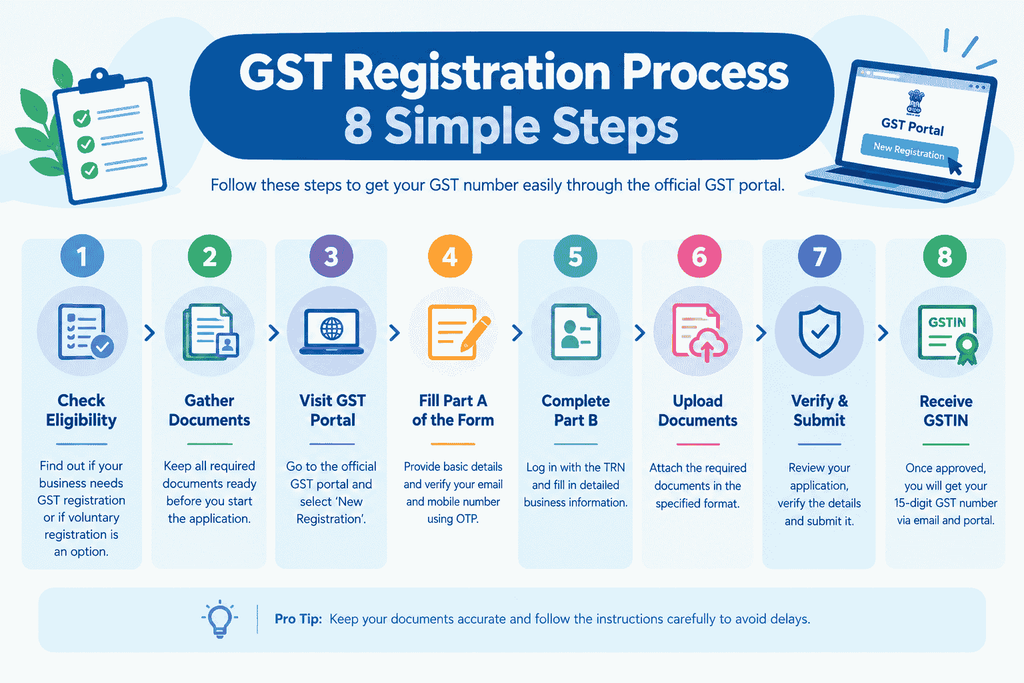
Step 3: Visit the GST Portal
Select the New Registration option when you visit the official GST Portal.
The common portal is used to complete the registration process electronically.
Step 4: Complete the Registration Form’s Part A
In the first part of the application, provide basic information such as:
- State or Union Territory
- District
- Legal name of the business (as per PAN)
- PAN
- Email address
- Mobile number
Your email address and mobile number are verified using One-Time Passwords (OTPs). A Temporary Reference Number (TRN) is generated following successful verification.
Step 5: Complete the application’s Part B.
Log in with the TRN and finish the detailed application.
You will typically provide:
- Business details
- Trade name (if any)
- Constitution of business
- Details of promoters or partners
- Authorized signatory information
- Principal place of business
- Additional places of business (if applicable)
- Goods and services supplied
- Required document uploads
The application also includes verification and authentication steps.
Step 6: Upload Supporting Documents
Upload all applicable documents in the prescribed format.
Examples include:
- Identity proof
- Address proof
- Business registration documents
- Business premises proof
- Photograph(s)
Ensure that all uploaded documents are clear and legible to avoid delays in processing.
Step 7: Verify and Submit the Application
Before submitting:
- Review every detail carefully.
- Verify that the PAN and business name are accurate.
- Verify contact details.
- Check uploaded documents.
Submit the application using the applicable electronic verification method, such as Aadhaar authentication, EVC, or Digital Signature Certificate (DSC), depending on the type of applicant.
Step 8: Receive Your GST Number
The GST department issues: after verification and approval are successful.
- GST Registration Certificate
- GST Identification Number (GSTIN)
If additional clarification is required, the proper officer may request further information before approval.
Documents Required for GST Registration
The documents required depend on the type of applicant, but commonly include:
Identity Documents
- PAN Card
- Aadhaar (where applicable)
- Passport-size photograph
Business Documents
- Partnership Deed (for partnerships)
- Certificate of Incorporation (for companies)
- LLP Agreement (for LLPs)
- Other constitution documents, as applicable
Business Address Proof
Examples may include:
- Electricity bill
- Property tax receipt
- Municipal records
- Rent or lease agreement (if applicable), along with ownership proof where required
Bank Details
Depending on current GST requirements, applicants may need to provide bank account information or furnish it after registration as permitted.
How Long Does GST Registration Take?
The length of time needed to register for the GST is determined by how complete the application is and whether additional verification is required.
Where the application is complete and no clarification is required, the proper officer generally processes eligible applications within the timelines prescribed under the GST Rules. If clarification is sought, processing may take longer.
Common Reasons GST Registration Gets Delayed
Applications may be delayed due to:
- Incorrect PAN details
- Mismatch in business information
- Unclear document uploads
- Invalid address proof
- Incorrect mobile number or email
- Failure to respond to clarification notices
Providing correct information helps minimize the chances of processing delays.
Common Mistakes to Avoid
Avoid the following mistakes when applying for a GST Number:
- Entering the wrong legal business name.
- Uploading blurred or incomplete documents.
- Providing incorrect PAN information.
- Using an inactive email or mobile number.
- Failing to verify the application before submission.
- Ignoring notices requesting clarification.
Tips for a Smooth GST Registration
Follow these best practices:
- Keep all documents ready before starting.
- Make sure the business name is consistent with the details recorded in the PAN database.
- Provide a valid and active email address along with a working mobile number.
- Upload high-quality document scans.
- Review every section before submission.
- Track your application status regularly.
Frequently Asked Questions (FAQs)
How to get GST number?
By completing the official GST Portal’s online GST registration process, submitting the required documents, and receiving approval from the GST authorities, you can obtain a GST Number.
Can I apply for a GST Number online?
Yes. The official GST Portal is the primary method of online registration for the GST.
What documents are required for GST registration?
Commonly required documents include:
- PAN Card
- Identity proof
- Business constitution documents
- Business address proof
- Photograph(s)
- Authorized signatory details
- Other documents depending on the business type.
Is GST registration free?
Yes. Applying for GST registration through the official GST Portal does not involve a government registration fee. However, professional service providers may charge fees if you hire them to assist with the application.
Can I apply for GST registration voluntarily?
Yes. Businesses that are not legally required to register may choose voluntary GST registration if it aligns with their business needs, subject to the applicable provisions of GST law.
How can I check my GST registration status?
Using the Application Reference Number (ARN), you can monitor your application’s progress on the official GST Portal after it has been submitted.
Conclusion
Understanding how to get GST number is an essential step for entrepreneurs, business owners, freelancers, and organizations that need to comply with India’s GST framework. The online registration process is designed to be straightforward when you prepare the necessary information and documents required in advance.
By completing your GST registration accurately, you can obtain a valid GST Identification Number, issue GST-compliant invoices, fulfill your tax obligations, and, where eligible, claim Input Tax Credit. Accurate documentation, careful review of your application, and timely responses to any clarification requests can help ensure a smoother approval process.