
Introduction
Whether you’re a business owner, accountant, supplier, freelancer, or customer, verifying the authenticity of a business before making a transaction is always a wise decision. One of the easiest ways to do this is through a GST dealer search.
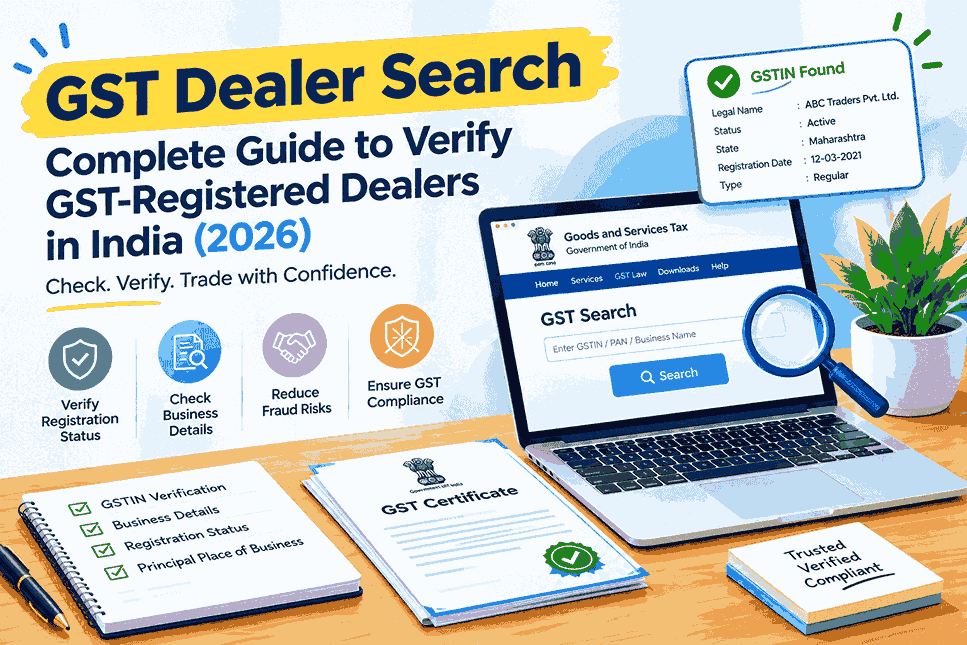
A GST dealer search helps you confirm whether a business is registered under the Goods and Services Tax (GST) system. It also allows you to verify important details such as the legal business name, GST registration status, registration date, taxpayer type, and principal place of business. This process helps businesses reduce compliance risks while giving customers greater confidence in the businesses they deal with.
In this complete guide, you’ll learn everything about GST dealer search, including its meaning, importance, available search methods, the information you can verify, common mistakes to avoid, and frequently asked questions.
What is GST Dealer Search?
GST dealer search is the process of verifying the registration details of a GST-registered taxpayer using official or authorized search facilities.
By searching a dealer’s GST information, you can check whether the business is:
- Registered under GST
- Active or cancelled
- Operating under the correct legal name
- Registered in the correct state
- Eligible to issue GST invoices
This verification is particularly useful before entering into commercial transactions or accepting tax invoices.
Who is a GST Dealer?
A GST dealer is a business or person registered under the Goods and Services Tax (GST) system who has been allotted a GST Identification Number (GSTIN).
Examples include:
- Sole proprietorships
- Partnership firms
- Limited Liability Partnerships (LLPs)
- Private Limited Companies
- Public Limited Companies
- One Person Companies (OPCs)
- Registered freelancers (where applicable)
- E-commerce sellers required to register
Every registered dealer receives a unique GSTIN for GST-related compliance.
Why is GST Dealer Search Important?
Verifying a GST-registered dealer offers several practical benefits.
1. Verify Business Authenticity
Before purchasing goods or services, you can confirm that the business is genuinely registered under GST.
2. Reduce Fraud Risks
Dealer verification helps identify fake or invalid GST Numbers before transactions take place.
3. Ensure Accurate GST Invoices
Businesses should ensure that invoices contain the correct GST details to maintain proper records.
4. Support GST Compliance
Accurate dealer information helps businesses maintain proper GST documentation and comply with applicable tax regulations.
5. Verify Suppliers and Vendors
Businesses often verify suppliers before placing large orders or claiming eligible Input Tax Credit (ITC).
When Should You Perform a GST Dealer Search?
A GST dealer search is useful in many situations.
You should verify a dealer when:
- Choosing a new supplier
- Receiving a GST invoice
- Beginning a long-term business relationship
- Making high-value purchases
- Conducting vendor verification
- Updating vendor records
- Reviewing compliance documents
Regular verification helps ensure that your business records remain accurate.
How to Perform a GST Dealer Search
The official GST system provides taxpayer search facilities that allow users to verify GST registration details. Search options typically include GSTIN/UIN, PAN (where available), and other authorized search methods.
A general process includes:
Step 1
Open the official GST taxpayer search service.
Step 2
Select the appropriate taxpayer search option.
Step 3
Enter the GST Identification Number (GSTIN) or other required information.
Step 4
Complete any required verification.
Step 5
Review the taxpayer information displayed.
Information You Can Verify During a GST Dealer Search
A successful GST dealer search may display information such as:
- GST Identification Number (GSTIN)
- Legal business name
- Trade name (if applicable)
- GST registration status
- Registration date
- Constitution of business
- Type of taxpayer
- Principal place of business
- State of registration
- Jurisdiction details
- Nature of business activities
The exact information shown may vary depending on the search method and access level.
GST Registration Status Explained
While searching a dealer, you may encounter different registration statuses.
Active
The GST registration is currently valid and active.
Cancelled
The registration has been cancelled according to GST records.
Suspended
The registration is temporarily suspended under applicable GST provisions.
Provisional or Other Statuses
Depending on the taxpayer’s circumstances and applicable rules, other registration statuses may also appear.
Understanding the status helps determine whether the business is currently operating with a valid GST registration.
Why Businesses Verify GST Dealers
Businesses routinely perform GST dealer searches for several reasons.
Vendor Onboarding
Before approving a new supplier, companies verify GST registration details.
Invoice Verification
Businesses confirm that the GST Number printed on invoices belongs to the correct taxpayer.
Record Accuracy
Dealer verification helps maintain reliable vendor information.
Internal Compliance
Businesses often verify GST details as part of their accounting and compliance procedures.
Benefits of GST Dealer Search
Benefits for Business Owners
- Verify supplier registrations
- Improve vendor management
- Reduce documentation errors
- Maintain accurate records
- Strengthen compliance processes
Benefits for Accountants
- Validate GST information
- Review supplier records
- Improve reconciliation accuracy
- Support return preparation
Benefits for Customers
Customers can:
- Confirm that a business is GST-registered
- Verify the business name
- Check the registration status
- Increase confidence before making purchases
Common Reasons Why Dealer Details May Not Appear
Sometimes a GST dealer search may not produce the expected result.
Possible reasons include:
Incorrect GST Number
Even a single incorrect character can prevent a successful search.
Cancelled Registration
The dealer’s registration may have been cancelled.
Typing Errors
Common mistakes include confusing:
- Letter O with number 0
- Letter I with number 1
Incorrect Search Information
Entering incomplete or incorrect taxpayer details may affect search results.
Tips for Accurate GST Dealer Search
Follow these best practices.
- Enter the complete 15-character GSTIN.
- Double-check spelling and numbers.
- Verify the state code.
- Compare the business name with the invoice.
- Review the registration status.
- Save verified records for future reference.
These simple steps help reduce verification errors.
Difference Between GST Dealer Search and GST Number Verification
Despite the fact that the terms are frequently used interchangeably, they are distinct.
| GST Dealer Search | GST Number Verification |
| Focuses on finding and reviewing taxpayer details | Confirms whether a GSTIN is valid |
| Displays dealer information | Confirms registration status |
| Used for vendor verification | Used for GSTIN validation |
| Helpful before business transactions | Helpful before accepting invoices |
In practice, both processes work together to confirm a taxpayer’s registration details.
Common Mistakes to Avoid
Avoid these errors while verifying GST dealers.
- Using an incomplete GST Number.
- Ignoring the registration status.
- Not matching the business name with the invoice.
- Failing to review the state code.
- Accepting invoices without verification.
- Relying on outdated business information.
Careful verification helps reduce compliance risks.
Best Practices for Businesses
Businesses should adopt these practices.
- Verify new suppliers before onboarding.
- Periodically review existing vendor GST details.
- Maintain updated vendor records.
- Match GST Numbers with invoices.
- Keep copies of important verification records.
- Follow official GST guidelines for compliance.
These practices improve transparency and strengthen internal controls.
Frequently Asked Questions (FAQs)
What is GST dealer search?
GST dealer search is the process of verifying the registration details of a GST-registered taxpayer using authorized GST search facilities.
Can I search a dealer using a GST Number?
Yes. The GST taxpayer search facility allows users to search for taxpayer details using a GST Identification Number (GSTIN).
What details can I verify?
You can generally verify:
- GST Number
- Business name
- Trade name
- Registration status
- Registration date
- Business address
- Taxpayer type
- Jurisdiction details
The information available depends on the search facility being used.
Why should I verify a GST dealer?
Dealer verification helps confirm business authenticity, supports accurate record keeping, and improves GST compliance.
Can customers perform a GST dealer search?
Yes. Public taxpayer search facilities are available for verifying basic GST registration details.
Is GST dealer search free?
Yes. The official GST taxpayer search facilities are available without charge.
Conclusion
A GST dealer search is an essential verification step for businesses, accountants, and consumers who want to confirm the authenticity of a GST-registered taxpayer. By checking details such as the GST Identification Number, legal business name, registration status, and principal place of business, users can make better-informed decisions before entering into commercial transactions.
Regular dealer verification not only supports accurate record keeping but also strengthens compliance with GST regulations and reduces the risk of dealing with incorrect or inactive registrations. Whether you are onboarding a new supplier, reviewing invoices, or simply confirming a business’s registration, performing a GST dealer search is a practical habit that promotes transparency and trust.