
Introduction
The Goods and Services Tax in India underwent its most significant update since its introduction in 2017. Popularly called GST 2.0, the next-gen GST reforms simplified the rate structure, cut the tax on many everyday goods, and promised faster registration and dispute resolution.
If you run a business, manage accounts, or simply want to understand why prices and invoices changed, this guide explains the reforms in plain language: what was announced, which rates changed, how the process reforms work, and what you should do now.
What Are the Next-Gen GST Reforms?
The next-gen GST reforms are a package of rate changes and procedural improvements designed to:
- Simplify the tax structure
- Reduce the burden on common households and small businesses
- Correct tax structures that hurt certain industries
- Make registration, refunds, and dispute resolution smoother
In short, they aim to make GST easier to follow, easier to comply with, and fairer across sectors.
Timeline of the Reforms
| Date | Event |
| 15 August 2025 | On Independence Day, the Prime Minister announced the next generation of GST reforms. |
| 3 September 2025 | 56th GST Council meeting approves the new structure |
| 17 September 2025 | Changes notified through CGST rate notifications |
| 22 September 2025 | Most new rates take effect |
GST Rate Structure Revised: From Four Tax Slabs to Two
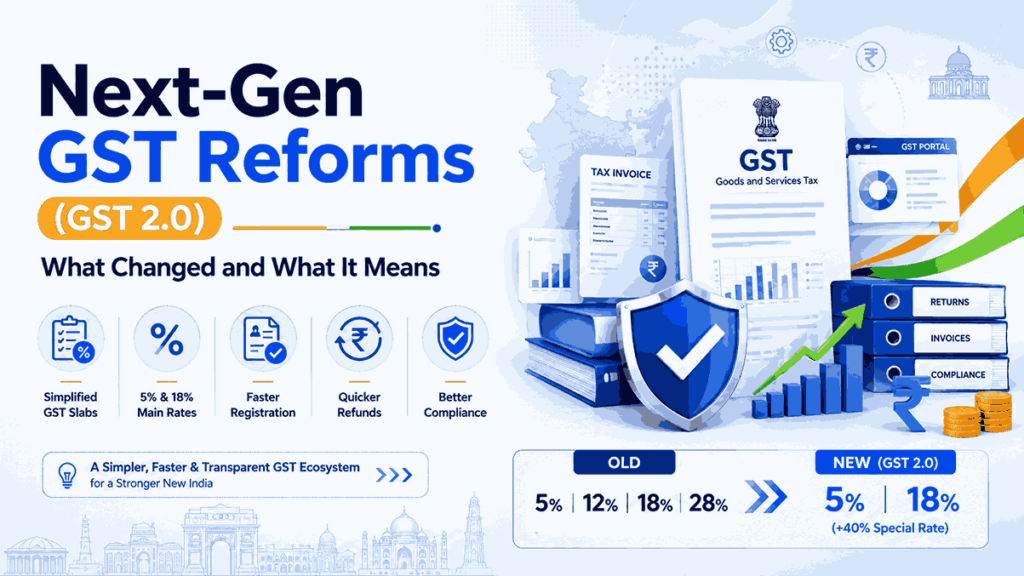
Before the reform, GST had four main slabs: 5%, 12%, 18%, and 28%. The reform removed the 12% and 28% slabs and merged most items into two.
| Slab | Role | Typical Coverage |
| 0% | Essentials | Basic food items and certain daily necessities |
| 5% | Merit rate | Essential and everyday goods |
| 18% | Standard rate | Most goods and services |
| 40% | Special rate | Select luxury and demerit goods |
This change alone removes a large amount of classification confusion, since many products used to sit awkwardly between 12% and 18%, or between 18% and 28%.
Key Rate Changes Under GST 2.0
Everyday Essentials
- Nil GST on items such as milk, paneer, chapati, and paratha
- 5% GST on many toiletries, medicines, bicycles, and farm tools
Consumer Goods and Appliances
- Small cars, televisions, air conditioners, and many home appliances moved from 28% to 18%
- Cement and many construction inputs also moved to 18%
Agriculture and Industry
- Reduced rates on agricultural machinery and fertiliser inputs
- Lower rates on renewable energy devices
- Correction of inverted duty structures in sectors such as textiles and fertilisers
Luxury Goods
- Large cars, SUVs, and similar vehicles above specified engine capacity are taxed at a flat 40%, replacing the earlier 28% plus cess
Rates for individual items depend on their HSN code and the latest notification, so always verify the exact rate for your product.
Before and After: A Quick Comparison
| Area | Before Reform | After Reform |
| Number of main slabs | 4 (5%, 12%, 18%, 28%) | 2 main slabs (5%, 18%) plus 40% special rate |
| Consumer appliances | 28% | 18% |
| Cement | 28% | 18% |
| Many packaged essentials | 12% | 5% or nil |
| Luxury vehicles | 28% plus cess | 40% flat |
What Is an Inverted Duty Structure, and Why Does It Matter?
An inverted duty structure arises when the tax on a business’s inputs is higher than the tax on its final product. The business then piles up unused input credit, which ties up working capital.
The reforms aimed to correct this in several sectors, including textiles and fertilisers, by bringing input and output rates into better balance. For affected businesses, this can mean smoother cash flow and fewer refund claims.
Process Reforms: Beyond Rates
The next-gen GST reforms were not only about percentages. They also targeted compliance and dispute resolution.
Faster Registration
- A simplified registration route, Rule 14A, offers system-based approval within about three working days for eligible low-risk applicants.
- It relies on automated checks and is optional.
Smoother Refunds
- Process changes aim to speed up refunds, especially in sectors affected by inverted duty structures.
Dispute Resolution
- The GST Appellate Tribunal (GSTAT) was planned to become operational, giving taxpayers a dedicated forum for appeals and faster resolution of disputes.
Check the official portal for the latest status of each of these measures, since timelines may have moved since the announcement.
Benefits of the Next-Gen GST Reforms
For Consumers
- Lower tax on many daily-use items
- Clearer pricing
- Potential savings on appliances and household goods
For Businesses
- Fewer slabs to track and fewer classification disputes
- Better cash flow where inverted duty was corrected
- Faster onboarding through simplified registration
- A dedicated tribunal for appeals
For Small Businesses
- Simpler registration
- Lower tax on many inputs and goods
- Less administrative friction
For the Economy
- A more unified and predictable tax system
- Stronger demand in sectors that saw rate cuts
- Improved ease of doing business
Challenges and Practical Concerns
The reforms are positive, but the transition brings real tasks:
- Updating systems: Billing and accounting software must use the new rates and HSN mappings.
- Repricing: Price lists, quotations, and contracts need review.
- Pass-through of benefits: The full tax cut does not always show up automatically in retail prices.
- Transition rules: Invoices and credit around the changeover date need care.
- Stock on hand: Goods bought at the older tax rate and sold after the change can raise credit questions.
- Staff training: Teams must learn the new slabs and exceptions.
Understanding the Transition: Input Tax Credit Around 22 September 2025
The date of supply decides which rate applies. As a simple illustration, a supply made before 22 September 2025 follows the old rate, while a supply made on or after that date follows the new rate. Input credit must be handled according to the applicable rate on each invoice. Mistakes at the changeover are a common source of mismatches in returns, so reconcile carefully and consult a tax professional where credit was affected.
What Should Businesses Do Now?
Use this checklist:
- Review your products and services to ensure they are aligned with the latest GST rate schedule.
- Confirm the HSN or SAC code for each item.
- Update billing and accounting software with the new rates.
- Revise price lists, quotations, and contracts.
- Check input credit on stock and purchases around the changeover.
- Reconcile returns regularly to catch mismatches early.
- Inform customers clearly about price changes and the tax shown on invoices.
- Train your team on the new structure.
- Keep records of rate decisions and notifications.
- Follow official notices, since further amendments can follow.
What Should Consumers Do?
- Check that the GST rate on your bill matches the current rate for the product.
- Compare prices before and after the change, not just the shelf label.
- Ask for an itemised invoice with the GST rate and amount.
- Buy from registered, transparent sellers.
- Report clear overcharging through the proper channels.
Common Misconceptions About the Reforms
“All items became cheaper.”
Not all. Many items saw cuts, but some categories carry a higher special rate, and final prices depend on the market.
“There are now only two slabs.”
Two main slabs remain, along with nil-rated items and a special 40% rate for select goods.
“Every product moved to 18%.”
No. Essentials moved to 5% or nil, and many items changed differently.
“Nothing changes for service providers.”
Several service rates were also revised, so service businesses should check their classification.
Frequently Asked Questions (FAQs)
1. What are the next-gen GST reforms?
They are the 2025 reforms, also called GST 2.0, that simplified GST slabs, cut rates on many goods, and improved registration and dispute resolution.
2. When did the new GST rates start?
Most changes took effect on 22 September 2025.
3. What are the new GST slabs?
The main slabs are 5% and 18%, with nil-rated items and a special 40% rate for select goods.
4. Were the 12% and 28% slabs removed?
Yes. Items from those slabs were mostly moved into 5% or 18%.
5. What is the GST rate on cement now?
18%, reduced from 28%.
6. Will prices always fall after a rate cut?
Not automatically. The tax component falls, but market prices depend on manufacturers and dealers.
7. Is GST registration faster now?
For eligible low-risk applicants under Rule 14A, approval can come in about three working days.
8. What is GSTAT?
The GST Appellate Tribunal is the forum for taxpayers to appeal against orders under GST.
9. Do I need to update my invoices?
Yes. Use the correct rate for each supply based on its date and classification.
Conclusion
The next-gen GST reforms brought a simpler, more consumer-friendly tax structure: two main slabs of 5% and 18%, a special 40% rate for select goods, relief on everyday essentials and appliances, and process improvements in registration, refunds, and appeals. For consumers, the goal is lower tax on daily needs. For businesses, it is easier compliance and better cash flow.
To benefit fully, update your systems, check classifications, reconcile credit, and keep up with official notifications. GST is a living system, and further changes can follow, so always confirm current details on the official GST portal.
Disclaimer: This article is for general information only and is not legal or tax advice. Rates and rules may change. Please verify with official sources or a qualified professional.