
Introduction
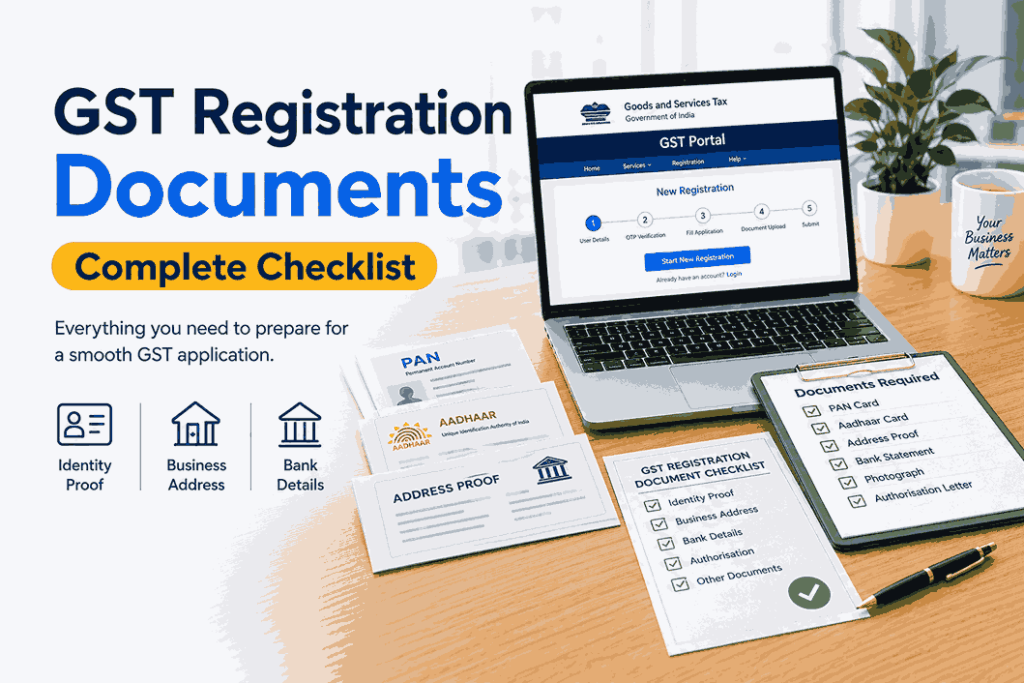
Getting a GSTIN is the first formal step for most Indian businesses. The online process is simple, but applications are often delayed or queried because of missing, mismatched, or poorly scanned documents. Preparing the right GST registration documents before you start can save days of back-and-forth.
This guide explains the documents needed for every type of applicant, how to prepare address and bank proofs, the file requirements, how the process works, and the mistakes that cause rejection.
Why Are GST Registration Documents Important?
The GST system relies on documents to confirm three things:
- Who you are: Identity of the proprietor, partners, or directors
- What you are: Your company’s legal name.
- Your primary place of business and bank account are located there.
Accurate documents mean faster approval, fewer queries from the tax officer, and a clean start to your compliance record.
Who Needs to Register for GST?
Registration is mandatory in certain situations, such as when turnover crosses the prescribed threshold, for specified inter-state suppliers, certain e-commerce sellers, and other categories listed in the law. Some businesses also register voluntarily.
Thresholds differ for goods and services and for special category states, and they can change, so confirm the current limit on the official GST portal before applying.
Basic GST Registration Documents for Every Applicant
Whatever your business type, expect to need the following:
- PAN: GST registration is PAN-based, so you cannot register without one.
- Aadhaar: Of the proprietor, partners, directors, or authorised signatory, for authentication.
- Photograph: A recent passport-size photo of the proprietor, partners, or directors.
- Proof of business constitution: Depends on your entity type (see below).
- Address proof of the principal place of business: Documents showing where you operate.
- Bank account proof: Showing your account details.
- Authorisation document for the signatory: A letter or resolution, where applicable.
- Mobile number and email address: Both must be active, since OTPs are sent to them.
GST Registration Documents by Business Type
1. Sole Proprietorship or Individual
- PAN of the proprietor
- Aadhaar of the proprietor
- Passport-size photograph
- Business address proof
- Bank account proof (personal or current account used for business)
- Trade licence or similar proof, if applicable to your business
2. Partnership Firm
- PAN of the firm
- Partnership deed
- PAN, Aadhaar, and photograph of all partners
- Authorisation letter for the authorised signatory
- Address proof of the principal place of business
- Bank account proof in the firm’s name
3. Limited Liability Partnership (LLP)
- PAN of the LLP
- LLP agreement and registration certificate
- PAN, Aadhaar, and photographs of designated partners
- Authorisation of the authorised signatory
- Address proof for the registered office or primary place of business.
- Bank account proof in the LLP’s name
- An active Digital Signature Certificate (DSC) belonging to the authorized signatory.
4. Private or Public Limited Company
- PAN of the company
- Certificate of Incorporation
- MOA and AOA
- PAN, Aadhaar, and photographs of directors
- Board resolution authorising the signatory
- Address proof of the registered office
- Bank account proof in the company’s name
- An active Digital Signature Certificate (DSC) belonging to the authorized signatory.
5. Hindu Undivided Family (HUF)
- PAN of the HUF
- PAN, Aadhaar, and photograph of the Karta
- Address proof of the business premises
- Bank account proof in the HUF’s name
6. Trusts, Societies, and Associations
- PAN of the entity
- Trust deed or registration certificate
- PAN, Aadhaar, and photographs of trustees or office bearers
- Address proof of the registered office
- Bank account proof in the entity’s name
7. Casual and Non-Resident Taxable Persons
These applicants register for temporary business and need additional items such as proof of the event or premises and an advance tax payment. Non-residents also need identity documents from their home country and an Indian authorised signatory. Check the official guidelines for these categories.
Address Evidence for the Primary Business Location
The application’s most error-prone component is address proof. How you hold the premises affects what you upload.
| Type of Premises | Documents Usually Required |
| Owned | Latest electricity bill, property tax receipt, or municipal Khata document as address proof. |
| Rented or leased | Rent or lease agreement, owner’s NOC (consent), and the owner’s latest utility bill or property tax receipt |
| Shared or co-working space | Agreement with the space provider, plus the owner’s address proof |
| Premises provided free of cost | A consent letter from the property owner along with the owner’s address proof. |
Key rules to remember:
- Utility bills should generally be not older than three months.
- Ensure that the address provided in the application matches the address mentioned in the supporting document.
- If your business operates from multiple locations, you must provide the details of each additional location’s address and supporting documentation.
Bank Account Proof
Provide any one of the following, showing clear details:
- scanned copy of the bank passbook’s first page
- Bank statement showing the account details
- Cancelled cheque
It should clearly display:
- Account holder’s name
- Account number
- IFSC code
- Bank and branch name
For firms, companies, and LLPs, the bank account should be in the entity’s name, not a personal one.
Identity and Photograph Requirements
- Identity proof is usually satisfied through PAN and Aadhaar.
- For partners and directors, additional identity proof such as a passport, voter ID, or driving licence may be required in some cases.
- Photographs should be recent, clear, and in the format specified on the portal.
File Format and Size Requirements
The GST Portal allows document uploads only in specific file formats and size limits. As a general guide:
- Documents are commonly accepted as PDF or JPEG.
- Each file typically has a maximum size limit (around 1 MB for most documents).
- Photographs have a smaller limit and a specific format.
Always check the current upload specifications on the portal, because they can change. Make sure scans are clear, complete, and readable.
Step-by-Step Registration Process
- Visit the GST Portal and select the “New Registration” option.
- Complete Part A by providing your PAN, mobile number, and email address. After OTP verification, you will receive a Temporary Reference Number (TRN).
- Sign in using your TRN and proceed to Part B of the registration process.
- Enter business details: Constitution, principal place of business, nature of business, goods or services (HSN/SAC), and bank details.
- Upload documents as listed above.
- Complete Aadhaar authentication for the authorised signatory.
- Verify and submit using EVC, or DSC where required, to receive the Application Reference Number (ARN).
- Track your application until the GSTIN is issued.
There is no government fee for GST registration. Standard applications are typically processed in about seven working days after authentication.
Simplified Registration Under Rule 14A
A newer optional scheme, Rule 14A, was introduced on 1 November 2025 for small and low-risk applicants.
- Eligible applicants can get system-based registration within three working days of the ARN.
- It uses automated PAN and Aadhaar matching and risk checks.
- You opt in through Part B of the application.
- Aadhaar authentication is required, and certain conditions apply.
Check the official notification to see whether your business qualifies.
Why Are GST Applications Rejected or Put Under Query?
- Name mismatch between PAN, Aadhaar, and bank records
- Address proof older than three months
- Missing NOC for rented premises
- Blurred or incomplete scans
- Wrong photo format or oversized files
- Mismatch between the address entered and the address on the proof
- Bank proof that does not clearly show the account holder’s name
- Missing authorisation for the signatory
- Incorrect business details or activity codes
If the officer needs clarification, you may receive a notice and will have a short period to respond, so reply promptly with correct documents.
Pre-Application Checklist
Before you begin, confirm that you have:
- Valid PAN of the applicant or business
- Aadhaar linked to an active mobile number
- Active email and mobile number
- Recent photographs
- Constitution proof (deed, certificate, or agreement)
- Proof of address for each place of business, together with a NOC if rented
- Bank proof in the correct name
- Authorisation letter or board resolution
- Digital Signature Certificate (DSC) is required if you are registering a company or LLP.
- Codes for your products or services from HSN or SAC
Tips for Smooth GST Registration
- Make sure the name and address are identical across all documents.
- Use recent utility bills.
- Scan documents in good quality and in the required format.
- Keep digital copies of all uploads for future reference.
- Choose the correct business constitution at the start.
- Provide truthful, accurate information only. False details can lead to rejection or cancellation later.
- Respond quickly to any query from the tax officer.
- If your case is complex, consult a qualified tax professional.
Frequently Asked Questions (FAQs)
1. What are the main documents required for GST registration?
PAN, Aadhaar, a photograph, evidence of the company’s address, evidence of its constitution, and evidence of its bank account
2. Is Aadhaar mandatory for GST registration?
Aadhaar authentication is generally required for the proprietor, partners, or authorised signatory, with limited alternatives in specific cases.
3. What address proof is accepted for rented premises?
A rent agreement, the owner’s NOC, and the owner’s recent utility bill or property tax receipt.
4. Is a DSC required for GST registration?
It is generally required for companies and LLPs. Proprietors and partnership firms can usually use Aadhaar-based EVC.
5. Can I use my personal bank account for GST registration?
A proprietor can generally use an account in their own name. Firms, companies, and LLPs need an account in the entity’s name.
6. Is there a fee for GST registration?
No, GST registration on the official portal is free of cost, and the government does not charge any registration fee.
7. How long does GST registration take?
Standard applications usually take around seven working days after authentication, while eligible Rule 14A applicants may get approval in three.
8. What if my utility bill is older than three months?
It may be rejected. Use the most recent bill available.
9. Can I register without business premises documents?
No. Address evidence of the primary business location is required.
Conclusion
The GST registration documents you need depend on your business type, but the core requirements are consistent: PAN, Aadhaar, photograph, proof of constitution, address proof, and bank proof. A DSC and authorization documents are also required for businesses and LLPs.The best way to avoid delays is to keep names and addresses consistent across every document, use recent proofs, upload clear scans, and provide accurate information.
With the checklist in this guide, you can prepare calmly and complete your application with confidence. Since rules and portal requirements are updated from time to time, always confirm the latest details on the official GST portal before applying.
Disclaimer: This article is for general information only and is not legal or tax advice. Requirements may change. Please verify with the official GST portal or a qualified professional.