
Introduction
Buying a bike is a big decision for most families, and the tax built into the price matters. After the 2025 GST reforms, the bike GST rate now depends largely on engine size and fuel type. Commuter motorcycles and scooters became cheaper, premium motorcycles became costlier, and electric bikes continued to enjoy a concessional rate.
This guide explains the GST on bikes, the rates for each category, how to calculate GST on a bike’s price, the rules on input tax credit, the tax on used bikes, parts, and accessories, and what the changes mean for buyers and dealers.
What Is the GST Rate on Bikes?
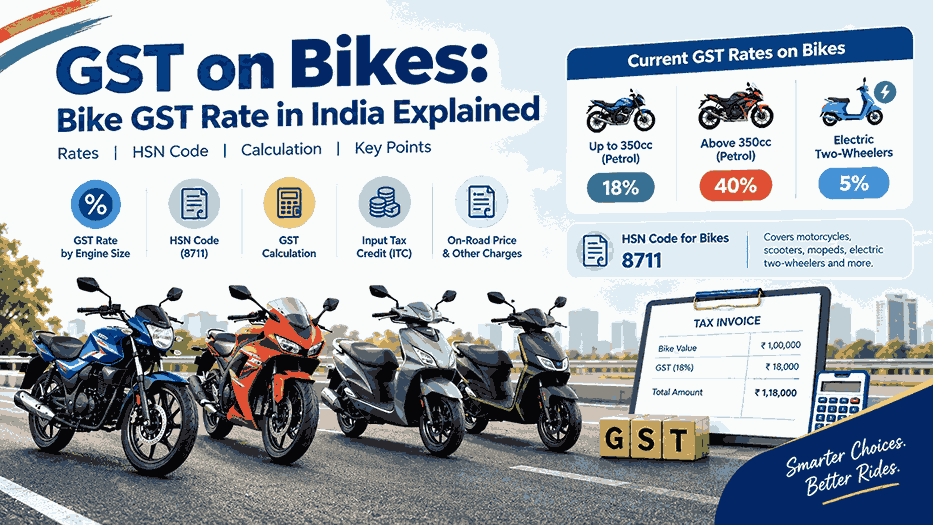
The GST rate on a bike depends on its category:
| Bike Category | GST Rate |
| Petrol motorcycles and scooters up to 350cc | 18% |
| Petrol motorcycles above 350cc | 40% |
| Electric two-wheelers (bikes and scooters) | 5% |
These rates took effect on 22 September 2025 under the GST rate reform.
Bike GST Rate: Before and After the Reform
| Category | Earlier Rate | Current Rate | Effect |
| Up to 350cc | 28% | 18% | Cheaper |
| Above 350cc | 28% plus 3% cess (about 31%) | 40% | Costlier |
| Electric two-wheelers | 5% | 5% | No change |
Because the vast majority of two-wheelers sold in India are 350cc or below, most buyers saw a lower tax rate. Larger, premium motorcycles moved into the special 40% slab meant for luxury goods.
Why Is the 350cc Limit Important?
The engine capacity is the dividing line between the standard and special rates.
- Up to 350cc: Treated as mainstream mobility and taxed at 18%.
- Above 350cc: Treated as premium or luxury and taxed at 40%.
Most scooters and commuter bikes fall below this limit. Many popular mid-range motorcycles sit close to it, so check the exact engine capacity in the manufacturer’s specification before estimating tax.
HSN Code for Bikes
Under GST, two-wheelers are classified under HSN 8711. This heading covers:
- Motorcycles and mopeds
- Scooters
- Electric two-wheelers
- Bicycles fitted with an auxiliary engine
Sub-classification within the heading depends on engine capacity and the type of propulsion. The correct HSN code on the invoice ensures the correct rate is applied.
How to Calculate GST on a Bike
The Formula
- GST Amount = Base Price × GST Rate ÷ 100
- Total Price = Base Price + GST Amount
Example 1: A 125cc Scooter at 18%
Prices are illustrative.
- Base price: ₹90,000
- GST at 18%: ₹16,200
- Price including GST: ₹1,06,200
Example 2: An Electric Scooter at 5%
- Base price: ₹1,00,000
- GST at 5%: ₹5,000
- Price including GST: ₹1,05,000
Example 3: A Premium Motorcycle Above 350cc at 40%
- Base price: ₹2,50,000
- GST at 40%: ₹1,00,000
- Price including GST: ₹3,50,000
Example 4: Removing GST From an Ex-Showroom Price
If the price shown is ₹1,18,000 and it includes 18% GST:
- Base Price = 1,18,000 × 100 ÷ 118 = ₹1,00,000
- GST Amount = 1,18,000 − 1,00,000 = ₹18,000
Price Impact: How Much Did the Rate Change Matter?
On the same ₹90,000 base price scooter:
| Rate | GST Amount | Price Including GST |
| 28% (earlier) | ₹25,200 | ₹1,15,200 |
| 18% (current) | ₹16,200 | ₹1,06,200 |
| Difference | ₹9,000 | ₹9,000 |
For a premium motorcycle at ₹2,50,000 base price:
| Rate | GST Amount | Price Including GST |
| About 31% (earlier) | ₹77,500 | ₹3,27,500 |
| 40% (current) | ₹1,00,000 | ₹3,50,000 |
| Difference | ₹22,500 | ₹22,500 |
The actual showroom price also depends on the manufacturer’s pricing decisions, so the final change may differ from this arithmetic.
CGST, SGST, and IGST on Bikes
The GST on a bike is split depending on the place of supply.
| Type of Sale | Tax Charged | Split at 18% |
| Within the same state | CGST + SGST | 9% + 9% |
| Between states | IGST | 18% |
For a 40% bike, the split within a state is 20% CGST and 20% SGST.
What Is Included in the On-Road Price?
GST is only one part of what you pay. A typical on-road price includes:
- Ex-showroom price (including GST)
- Registration charges
- Road tax or lifetime tax, which is set by the state
- Accessories and optional extras
- Handling or documentation charges
Registration and road tax are state-level charges and are separate from GST, so they vary by location.
GST on Electric Bikes and Scooters
Electric two-wheelers are taxed at a concessional 5%, no matter the battery capacity or whether the vehicle is a scooter or motorcycle.
Why this matters:
- The tax component is much lower than the 18% on petrol models.
- Lower tax helps narrow the price gap with petrol vehicles.
- Running costs are often lower, depending on usage.
- Some states offer additional incentives, which are separate from GST.
Always confirm the current rate and any state incentives before buying.
GST on Bike Parts and Accessories
Spare parts and accessories carry their own GST rates, usually under their respective HSN codes. Commonly:
- Helmets: about 18%
- Tyres and tubes: about 18%
- Engine parts, mirrors, and many other components: about 18%
In a workshop, service labor is charged separately and subject to its own GST treatment. Check the invoice for the HSN or SAC code and the rate charged.
GST on Used Bikes
For second-hand bikes:
- If a private individual sells a bike directly to another individual, GST is generally not charged.
- If a registered dealer sells a used bike, GST is usually calculated on the dealer’s margin (the difference between the selling price and purchase price) and not on the full price.
- The applicable rate for this margin depends on the category of the vehicle.
Because rules for used vehicles are technical, confirm the treatment with your dealer or a tax professional.
Input Tax Credit (ITC) on Bikes
ITC on two-wheelers is limited.
When ITC Is Generally Not Available
- When a business buys a bike for personal use or for staff
- When the bike is bought for ordinary business use that does not fall under an exception
When ITC May Be Available
- When the bike is bought for resale by a dealer
- When it is used for passenger transportation, such as a two-wheeler taxi service
- When it is used for training in driving, where the law allows
These are exceptions under the blocked-credit rules, so confirm eligibility before claiming credit.
Who Is Affected by the Bike GST Rate?
- Commuters and families: Lower tax on mainstream motorcycles and scooters
- Delivery and gig workers: Reduced purchase costs on smaller bikes
- Enthusiasts and premium buyers: Higher tax on larger motorcycles
- Dealers: Must update pricing, invoices, and stock valuation
- Manufacturers: Adjust pricing and product strategy
- Service and parts businesses: Verify rates on parts and labour
Tips for Buyers
- Check the engine capacity to know whether your bike falls under 18% or 40%.
- Compare the ex-showroom price with the on-road price to see the full cost.
- Ask for an itemised invoice showing the HSN code and the GST rate.
- Ask the dealer whether current prices already reflect the latest rate.
- Check state charges separately, since they vary.
- Buy from authorised, registered dealers and keep all invoices.
Tips for Dealers and Businesses
- Update billing software with the correct HSN and rate for each model.
- Display GST clearly on quotations and invoices.
- Review stock bought at older rates and how it affects pricing and credit.
- Handle used-bike sales according to the margin rules.
- Train sales staff to explain the tax component honestly and accurately.
- Be transparent with customers. Fair dealing builds long-term trust.
Common Mistakes Related to GST on Bikes
- Using the old 28% rate for bikes up to 350cc
- Applying 18% to bikes above 350cc
- Assuming the whole on-road price is taxed at the GST rate
- Mixing up road tax or registration charges with GST
- Claiming ITC on a bike bought for ordinary use
- Ignoring the 5% concession on electric two-wheelers
- Relying on outdated websites for rates
Frequently Asked Questions (FAQs)
1. What is the GST rate on bikes in India?
18% for petrol bikes and scooters up to 350cc, 40% for those above 350cc, and 5% for electric two-wheelers.
2. What is the GST on a 100cc or 125cc bike?
18%, since both are below the 350cc limit.
3. What is the GST on bikes above 350cc?
40%, which replaced the earlier 28% plus 3% cess.
4. When did the new bike GST rates start?
On 22 September 2025.
5. What is the GST on electric bikes and scooters?
5%.
6. What is the HSN code for bikes?
HSN 8711.
7. Is road tax included in GST?
No. Road tax and registration charges are separate and set by each state.
8. Can I claim ITC on a bike?
Generally no, except in specific cases such as resale or passenger transport.
9. Is GST charged on used bikes?
Private sales between individuals generally do not attract GST, while dealer sales are usually taxed on the margin.
10. Is GST applied on accessories separately?
Yes. Accessories and parts have their own rates, often around 18%.
Conclusion
The bike GST rate now follows a simple pattern: 18% for petrol bikes and scooters up to 350cc, 40% for those above 350cc, and 5% for electric two-wheelers. The 2025 reform made everyday motorcycles and scooters cheaper in tax terms, while premium models moved to a higher slab.
Knowing the rate for your engine size, checking the HSN code on the invoice, and understanding what the on-road price includes will help you budget accurately and avoid billing errors. GST rates can be revised again, so always confirm the current rate on the official GST portal before buying or invoicing.
Disclaimer: This article is for general information only and is not legal or tax advice. Prices are illustrative, and rates may change. Please verify with official sources or a qualified professional.