
Introduction
Few GST concepts matter as much to a business’s cash flow as input tax credit. Without it, tax would pile up at every stage of the supply chain and prices would climb. With it, a business pays tax only on the value it adds.
However, ITC is also where the majority of errors occur. Missed deadlines, unmatched invoices, and claims on ineligible purchases can lead to lost credit and notices. This guide explains ITC in GST, how to claim ITC, the main GST ITC rules, blocked credits, reversals, and the habits that keep your claims safe.
What Is Input Tax Credit?
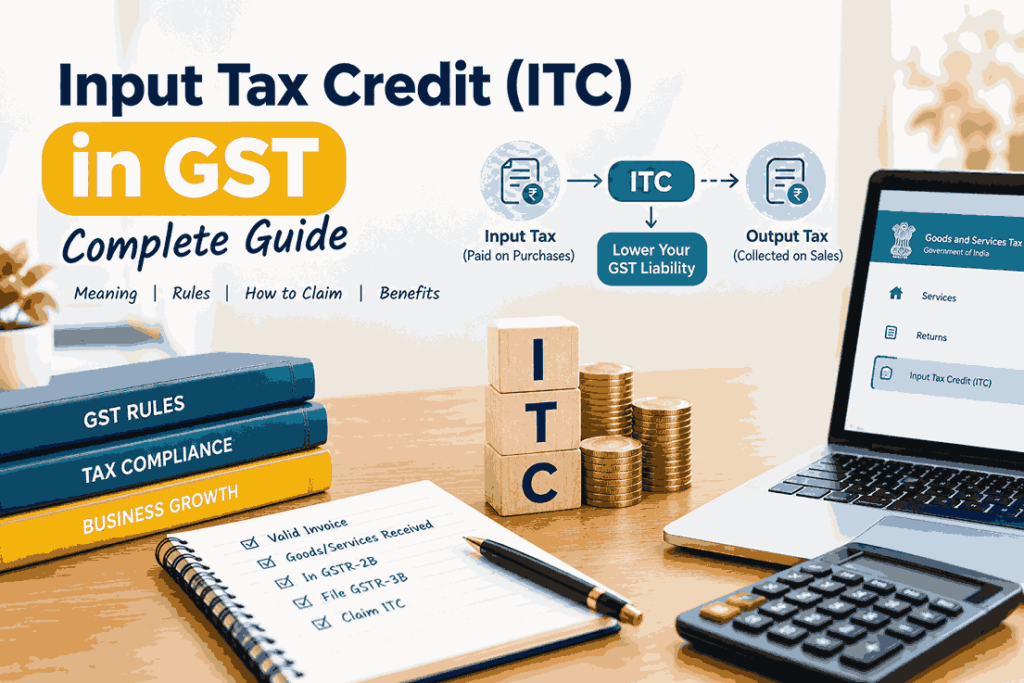
Input Tax Credit (ITC) is the credit a registered business can take for the GST it has paid on purchases of goods and services used for its business. That credit is then set off against the GST the business must pay on its own sales.
In simple terms:
- Input tax: GST you pay when you buy
- Output tax: GST you collect when you sell
- ITC: The input tax you are allowed to deduct from your output tax
Net GST payable = Output GST − Eligible ITC
Why Is ITC Important?
- Avoids tax on tax: You are taxed only on the value you add.
- Lowers your tax payment: Eligible credit reduces the cash you pay to the government.
- Improves cash flow: Less money is tied up in tax.
- Keeps prices fair: Without credit, taxes would build into the cost of goods.
- Encourages formal billing: Buyers want proper invoices, which promotes transparent trade.
How Does ITC Work? A Simple Example
Imagine a furniture workshop.
- It buys timber, hardware, and packaging and pays ₹32,000 GST on these purchases (input tax).
- It sells finished furniture and collects ₹50,000 GST from customers (output tax).
| Item | Amount |
| GST collected on sales (output) | ₹50,000 |
| GST paid on purchases (input, eligible) | ₹32,000 |
| GST payable in cash | ₹18,000 |
The workshop pays only ₹18,000 because it takes credit for the ₹32,000 it already paid to its suppliers.
Who Can Claim ITC?
ITC is available to:
- Businesses registered under GST that make taxable supplies
- Registered persons using the goods or services for business purposes
ITC is generally not available to:
- Unregistered persons
- Final consumers buying for personal use
- Businesses making only exempt supplies, for credit on related inputs
- Taxpayers under the composition scheme
Conditions to Claim ITC (GST ITC Rules)
ITC is not an inherent right but rather a conditional benefit. In general, all of the following must be met:
- You possess a valid document, such as a tax invoice or another required document.
- Goods or services received: You have actually received them.
- Reflected in GSTR-2B: Your automatically generated GSTR-2B contains information about the supplier.
- Tax paid by the supplier: The supplier has filed returns and paid the tax to the government.
- Return filed: You have filed your own GSTR-3B for the period.
- Within the time limit: You file your claim before the legal deadline.
- Payment to supplier: You pay the supplier within the prescribed period (see the 180-day rule below).
If even one condition fails, the credit can be denied or reversed.
Understanding GSTR-2B and ITC
GSTR-2B is a static monthly statement generated from your suppliers’ filed returns. It displays the credit you have available for that month.
- It is the primary source for your claims.
- It updates only when suppliers file their returns on time.
- If a supplier does not file, the invoice will not appear and you generally cannot claim that credit.
Many businesses also use the Invoice Management System (IMS) on the GST portal, which lets you accept, reject, or hold invoices before they flow into your credit. Check the latest portal instructions for how it applies to you.
Time Limit to Claim ITC
Section 16(4) sets an outer limit for claiming credit on an invoice or debit note. Under the current framework, the limit is generally the earlier of:
- 30 November following the end of the financial year to which the invoice relates, or
- The date you file the annual return for that year
Missing the deadline can mean the credit is lost for good, so do not leave claims until the last month. Always confirm the exact deadline for your year on the official portal, as dates and relief provisions have been amended over time.
Blocked Credits (Section 17(5))
Some purchases are not eligible for ITC even with a valid invoice. Common categories include:
- Certain motor vehicles, with exceptions for specific uses such as transport or training businesses
- construction of immovable property for personal use, frequently
- Goods or services for personal consumption
- Goods lost, stolen, destroyed, or given as gifts or free samples
- Certain travel benefits given to employees
Exceptions exist in several categories, so check the exact provisions or ask a professional before assuming a purchase is blocked or allowed.
ITC on Mixed-Use and Exempt Supplies
If you use a purchase partly for business and partly for personal purposes, or for both taxable and exempt supplies, only the eligible portion of credit can be claimed.
- Personal portion: Not eligible.
- Exempt supplies: Credit related to them must be reversed under the apportionment rules.
- Common inputs: Credit used for both taxable and exempt activity is split using a prescribed formula.
The 180-Day Payment Rule
You are required to reverse the ITC you claimed along with any applicable interest as required by law if you do not pay your supplier within 180 days of the invoice date.You can claim it again after you make the payment, subject to the rules.
For instance, you claim the credit after receiving an invoice dated March 1. If the supplier is still unpaid after 180 days, reverse the credit and re-claim it once the payment is made.
How ITC Is Utilised: The Order of Set-Off
Credit is not interchangeable across all tax heads. The general order is:
| Credit Type | Can Be Used For (in order) |
| IGST credit | IGST first, then CGST, then SGST/UTGST |
| CGST credit | CGST first, then IGST (not SGST) |
| SGST/UTGST credit | SGST/UTGST first, then IGST (not CGST) |
Understanding this order helps you plan your payments and avoid paying more cash than necessary.
How to Claim ITC: Step by Step
- Collect valid invoices. Make sure each shows the supplier’s GSTIN, your GSTIN where required, and the correct tax details.
- Confirm receipt. Verify that the products or services were received.
- Download GSTR-2B. Examine the available credit for the month.
- Reconcile with your books. Compare your purchase records with GSTR-2B and identify any discrepancies.
- Follow up with suppliers. Ask them to file returns or correct errors for missing invoices.
- Separate ineligible credit. Remove blocked and personal-use items.
- Claim in GSTR-3B. In the appropriate table, indicate the eligible ITC.
- Review before filing. Check the figures one last time.
- Pay on time. Pay supplier invoices within the allotted time frame.
ITC Reversal: When Must You Reverse Credit?
You may need to reverse previously claimed ITC when:
- Payment to the supplier is not made within the stipulated 180-day period.
- Goods are used for exempt supplies or personal purposes
- A credit note is issued reducing the supplier’s tax
- Goods are lost, stolen, destroyed, or written off
- Credit was claimed on a blocked or ineligible item
Reversal is reported in your GSTR-3B. Delayed reversal can attract interest.
ITC on Reverse Charge, Imports, and Services
- Reverse Charge (RCM): Where you pay GST under reverse charge, you can generally claim ITC on it if the other conditions are met.
- Imports: IGST paid on imports can be claimed as credit, subject to the rules.
- Services: The same conditions apply to services, including professional, repair, and maintenance work used for business.
Common Mistakes When Claiming ITC
- Submitting a credit claim without the invoice being recorded in GSTR-2B
- Missing the Section 16(4) deadline
- Claiming credit on blocked items such as personal expenses
- Not paying suppliers within 180 days
- Not reconciling monthly purchase records with GSTR-2B
- Dealing with suppliers who do not file returns
- Claiming more than your records support
- Ignoring credit notes and debit notes
Tips to Protect Your ITC
- Reconcile GSTR-2B with your books every month, not once a year.
- Choose suppliers who file returns on time, and verify their GSTIN.
- Keep invoices, payment proofs, and delivery records organised.
- Set internal deadlines well before the statutory ones.
- Review blocked credit categories before claiming.
- Train your accounts team on current rules.
- Seek professional advice for complex claims.
- Always claim only what you are truly entitled to. Honest, accurate reporting protects your business and its reputation.
Frequently Asked Questions (FAQs)
1. What is input tax credit?
It is the credit for GST paid on business purchases that can be deducted from your sales-related GST liability.
2. What does ITC in GST mean?
ITC stands for Input Tax Credit, the mechanism that prevents tax from being charged on tax.
3. How do I claim ITC?
Make sure the invoice appears in GSTR-2B, meet all conditions, and report the eligible amount in your GSTR-3B.
4. Can I claim ITC if my supplier has not filed returns?
Generally no. The invoice will not appear in GSTR-2B until the supplier files.
5. What is the time limit to claim ITC?
Broadly, it is the earlier of 30 November following the financial year or the annual return filing date. Check the official portal to confirm the current deadline.
6. Which purchases are not eligible for ITC?
Blocked items under Section 17(5), such as certain vehicles, food and beverages, club memberships, and goods for personal use.
7. What is the 180-day rule?
If you do not pay your supplier within 180 days, you must reverse the ITC and can re-claim it after payment.
8. Can ITC be used to pay any GST?
No. It must follow the set-off order across IGST, CGST, and SGST.
9. Is Input Tax Credit (ITC) available for expenses incurred for personal use?
No. Only business-use purchases qualify.