
Introduction
Gold is widely purchased in India for jewellery, investment, and traditional occasions, so it is no surprise that “GST on gold” is a popular search. Buyers want to know how much tax will appear on the bill, and jewellers want to invoice correctly.
The good news is that the gold GST rate is simple compared with many other goods. This guide explains the current rate, how charges are taxed, how to calculate your final bill, what happens when you exchange old gold, and the mistakes to avoid.
What Is the GST Rate on Gold?
The GST rate on gold is 3% of its value. This applies to gold in the form of:
- Gold coins
- Gold bars and biscuits
- Gold jewellery and ornaments
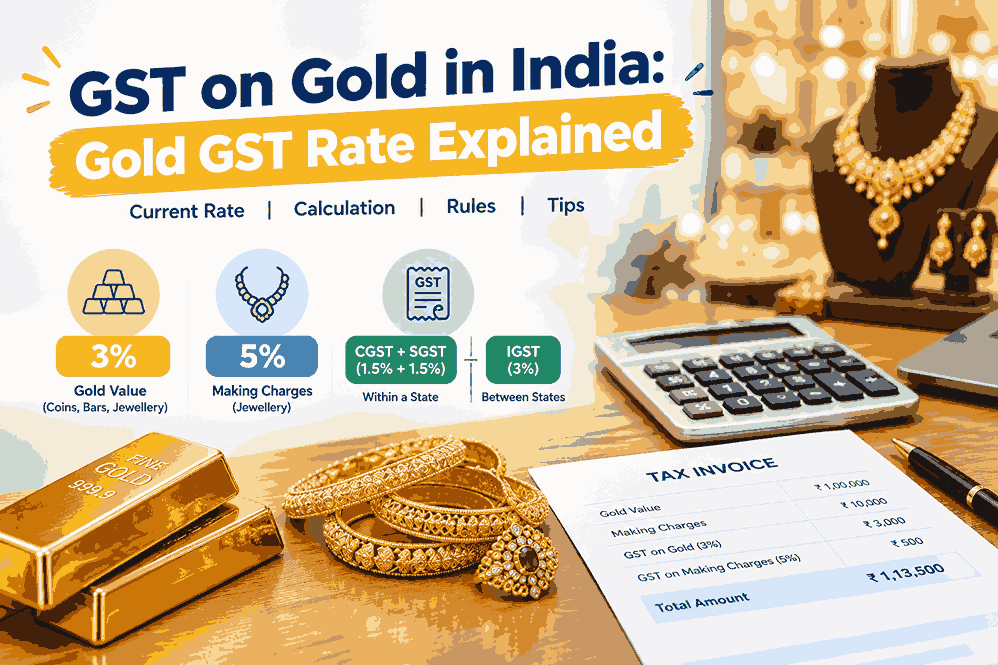
Because the rate is 3%, a purchase of ₹1,00,000 worth of gold carries ₹3,000 in GST. The tax is split equally for sales within a state: 1.5% CGST + 1.5% SGST. There is a 3% IGST on sales between states.
GST on Making Charges
Jewellery involves craftsmanship as well as metal. The labour or design cost is called making charges.
- Making charges attract 5% GST in common billing practice.
- Within a state, this splits into 2.5% CGST and 2.5% SGST.
- Coins and bars usually have little or no making charges, so they carry only the 3% tax on the gold value.
| Component | GST Rate |
| Gold value (coins, bars, jewellery) | 3% |
| Making charges on jewellery | 5% |
Does Purity or Carat Change the GST Rate?
No. GST on 22-carat gold is the same as GST on 24-carat gold, which is 3% on the metal value. Purity affects the price of the gold, not the tax percentage. A higher price simply means a higher tax amount at the same rate.
How to Calculate GST on Gold
The Formula
- Gold Value = Weight (grams) × Gold Rate per gram
- GST on Gold = Gold Value × 3% ÷ 100
- GST on Making Charges = Making Charges × 5% ÷ 100
- The Gold Value, Expenses, GST on Gold, and GST on Expenses comprise the Final Cost.
Example 1: Gold Jewellery
These figures are illustrative, not live gold rates.
- Gold value: ₹1,00,000
- Making charges: ₹10,000
- GST on gold (3%): ₹3,000
- GST on making charges (5%): ₹500
- Final bill: ₹1,13,500
Example 2: Gold Coin With No Making Charges
- Gold value: ₹50,000
- GST at 3%: ₹1,500
- Final bill: ₹51,500
Example 3: Finding Making Charges as a Percentage
Making charges are often quoted as a percentage of the gold value. If the gold value is ₹80,000 and the jeweller charges 10%:
- Making charges = ₹8,000
- GST on making charges at 5% = ₹400
- GST on gold at 3% = ₹2,400
- Total GST = ₹2,800
Jewellery vs Coins and Bars: Which Carries More Tax?
| Feature | Jewellery | Coins and Bars |
| GST on gold value | 3% | 3% |
| Making charges | Usually significant | Usually minimal or none |
| GST on making charges | 5% | Little or none |
| Overall tax burden | Higher | Lower |
Jewellery costs more overall because making charges add a second layer of tax. Coins and bars are simpler, with a bill that shows mainly the gold value plus 3%.
How a Jeweller Should Bill: A Note on Making Charges
In practice, most jewellers issue invoices by listing the gold value and making charges separately, applying 3% GST on gold and 5% GST on making charges. However, under GST law, the tax treatment differs depending on the nature of the transaction:
- Job work: When a customer gives their own gold and pays only for labour, the labour is a service taxed at 5%.
- Sale of finished jewellery: When a jeweller sells ready-made jewellery as goods, some tax commentary notes that the entire value, including making charges, may be treated as one supply taxed at 3%.
Because practice and interpretation can vary, jewellers should confirm the correct treatment with their tax advisor, and customers should simply check that the invoice states the rates and amounts clearly.
GST When You Exchange Old Gold
Exchanging old jewellery for new is common. In general:
- The value of your old gold is adjusted against the new purchase.
- GST is charged on the making charges and any additional value you pay.
- Practices can vary by jeweller, so ask how the bill is structured before you agree.
If a registered jeweller buys old gold from an unregistered seller, special reverse charge rules may apply to the jeweller. A private individual selling their own old jewellery is generally not required to charge GST.
GST on Gold Repairs and Customisation
- Repairs and polishing: Charges for repair or polishing services are taxed as services, usually at 5%.
- Custom orders: Where a jeweller crafts a piece to your design, the gold value and making charges are generally billed separately.
- Customer-supplied gold: If you provide the metal, GST usually applies to the making or job work charges.
GST on Imported Gold
Gold brought into India for sale is subject to customs duty and IGST at 3%. Jewellers and importers also claim input credit on the GST they pay, subject to the rules. All of this is only reflected in the final price for ordinary consumers.
Why Do Making Charges Vary So Much?
Making charges are set by the jeweller and are not fixed by law. They commonly depend on:
- The complexity of the design
- Whether the piece is handmade or machine-made
- The weight and size
- The brand and shop
- Promotions and negotiations
A lower making charge also reduces the tax you pay because GST is added on top.It is worth comparing offers before buying.
How to Read Your Gold Invoice
A proper invoice should show:
- The seller’s name and GSTIN
- A description of the item, with weight and purity
- The gold rate per gram on the day
- Gold value
- Making charges
- GST on gold and GST on making charges, shown separately
- The total amount payable
Keep the invoice safe. It is useful for warranty, resale, and your own records.
Tips for Buyers
- Compare the total price, not just the gold rate per gram.
- Ask for the making charges to be shown separately.
- Negotiate making charges, since they affect both cost and tax.
- Choose coins or bars if you want a lower tax burden and no craftsmanship cost.
- Always take a valid GST invoice.
- Check that the rate and the arithmetic on the bill are correct.
- Buy from trusted, registered sellers.
Tips for Jewellers
- Issue accurate, itemised invoices with the correct GST rates.
- Update prices daily with the gold rate.
- Keep records of purchases, sales, and old gold transactions.
- Claim input credit only on eligible purchases.
- Review GST Council updates regularly.
- Be transparent with customers about all charges. Honest billing builds long-term trust.
Common Mistakes Related to GST on Gold
- Assuming 22-carat gold is taxed differently from 24-carat gold
- Ignoring GST on making charges when budgeting
- Comparing only rates per gram rather than total costs
- Not asking for an itemised invoice
- Forgetting that the old gold exchange has its own billing treatment
- Using outdated rates from unofficial sources
Frequently Asked Questions (FAQs)
1. What is the GST rate on gold in India?
It is 3% of the gold’s value, whether it’s in bars, coins, or jewelry.
2. What is the GST on making charges?
In common billing practice it is 5% on the making charges of jewellery.
3. Is GST the same on 22-carat and 24-carat gold?
Yes. Purity does not change the GST rate.
4. Do I pay GST on gold coins and bars?
Yes, at 3% on the value. They usually carry little or no making charges.
5. Is GST charged when I exchange old gold jewellery?
GST is generally applied on the making charges and extra value, not on the value of old gold you return, although practice varies by jeweller.
6. Is GST split into CGST and SGST for gold?
Yes, within a state the 3% is split into 1.5% CGST and 1.5% SGST.
7. How do I calculate the final price of gold jewellery?
Add the gold value, making charges, and the GST on both.
8. Do gold rates change the GST amount?
The rate stays 3%, but when the gold price rises, the tax amount rises with it.
Conclusion
The gold GST is straightforward: 3% on the gold’s value and 5% on making charges in common practice for jewelry.The rate is the same for 22-carat and 24-carat gold, and coins and bars generally carry a lighter total tax because they have little or no making charges.
By comparing total bills, asking for itemised invoices, and checking the rates, buyers can purchase with confidence, and jewellers can keep their records accurate. GST rules are reviewed from time to time, so always confirm current rates on the official GST portal.
Disclaimer: This article is for general information only and is not legal, tax, or financial advice. Figures are illustrative, and rates may change. Please verify with official sources or a qualified professional.