
Introduction
When you buy a product or service in India, the tax you pay depends on the GST slab it falls under. Rice, a smartphone, a haircut, and a luxury car are not taxed at the same rate, and knowing why helps businesses price correctly and helps customers read their bills with confidence.
India’s slab structure was simplified in September 2025, so older articles and printed charts are now out of date. This guide explains what GST slabs are, the current GST tax rates, the GST percentages applied to common items, and how to use the correct slab in your calculations.
What Are GST Slabs?
GST slabs are the fixed tax percentages the GST Council assigns to different categories of goods and services. Instead of one flat rate for everything, the system uses a few tiers so that:
- The necessities are taxed lightly, if at all.
- Everyday goods and services carry a moderate rate.
- Luxury and harmful products carry the highest rate.
Every item is placed in a slab according to its classification code (HSN for goods, SAC for services).
Who Decides the GST Tax Rates?
The GST Council, a joint body of the Union Finance Minister and state finance ministers, decides rates, exemptions, and slab changes. Its recommendations are then notified by the government. Since GST rates may be revised following a GST Council meeting, it is advisable to verify the latest applicable rate through official sources before issuing an invoice.
The Old Structure: Before September 2025
For years, GST had four main slabs:
- 5%
- 12%
- 18%
- 28% (with an additional compensation cess on some products)
Many products sat awkwardly between slabs, which led to classification disputes and confusion. This was a key reason for the reform.
Current GST Slabs in India
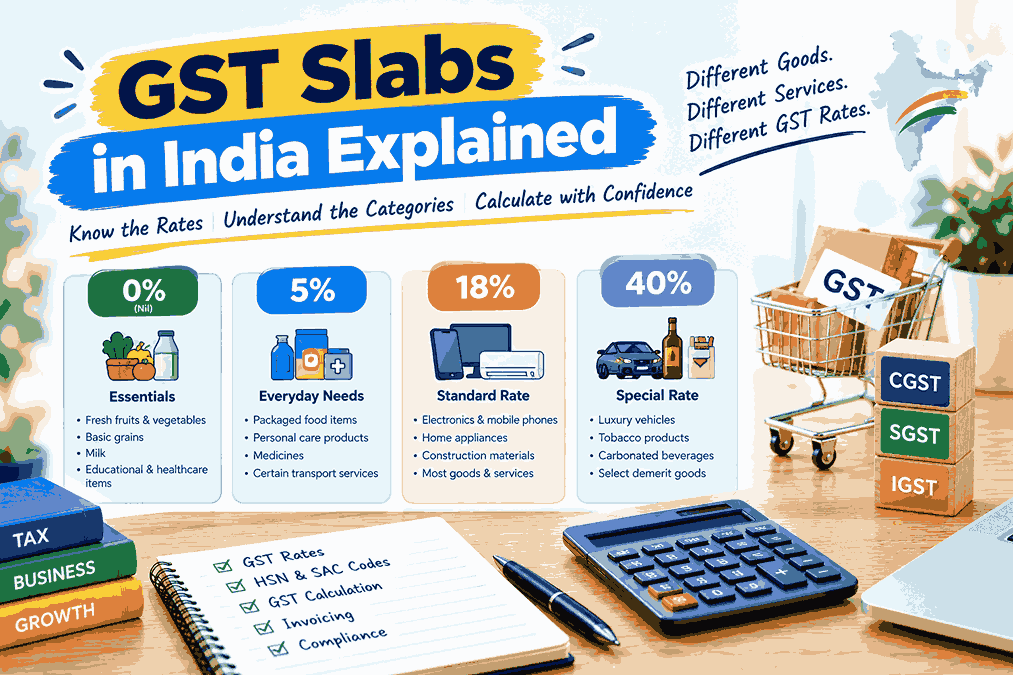
The structure is supported by these slabs following the implementation of the GST 2.0 reform, which took effect on September 22, 2025:
| Slab | Purpose | What It Covers |
| 0% (Nil) | Protect essentials | Basic food items, certain educational and healthcare items |
| 5% | Everyday needs | Common household goods, many packaged foods, medicines |
| 18% | Standard rate | Most goods and services |
| 40% | Special rate | Select luxury and demerit goods |
The old 12% and 28% slabs were removed for most items, and those goods moved into the 5% or 18% slabs. A few special rates also remain for specific items, such as precious metals and rough diamonds. Check the official rate schedule for these.
GST Tax Rates Explained, Slab by Slab
0% GST (Nil-Rated and Exempt)
This slab is meant to keep basic necessities affordable.
- Fresh fruits and vegetables
- Basic grains and unbranded staples
- Fresh milk
- Certain educational items such as notebooks and pencils
- Some life-saving medicines
- Specified healthcare and education services
5% GST (Merit Rate)
This slab covers goods and services that households use regularly.
- Many packaged food items such as butter, ghee, and dry fruits
- Everyday personal-care items such as soap, shampoo, and toothpaste
- Many medicines
- Specified transport and other services
18% GST (Standard Rate)
The majority of businesses deal with this main slab.
- Most manufactured goods and consumer products
- Mobile phones and many electronics
- Air conditioners, televisions, and dishwashers
- Cement and many construction materials
- Small cars and motorcycles up to 350cc
- Most business and professional services, including consulting, IT, and design
GST at a Special Rate of 40% This slab applies to a limited list of luxury and government-classified demerit goods, such as certain luxury vehicles, tobacco products, and some carbonated beverages.
What Changed Under GST 2.0?
| Before (Old Structure) | After (Current Structure) |
| 5%, 12%, 18%, 28% slabs | 0%, 5%, 18%, 40% slabs |
| Many items split across 12% and 28% | Most 12% items moved to 5% or 18% |
| 28% items plus cess | Most moved to 18%, with luxury and demerit goods at 40% |
| More classification disputes | Simpler classification |
The aims of the reform were simpler compliance, fewer disputes, and easier pricing for everyday goods.
How the Slab Affects Your Final Price
The amount of tax added to the base price is determined by the slab you use. Here is the same ₹10,000 item at different rates:
| Slab | GST Amount | Total Price |
| 5% | ₹500 | ₹10,500 |
| 18% | ₹1,800 | ₹11,800 |
| 40% | ₹4,000 | ₹14,000 |
The calculation is simple:
- GST Amount = Price × Rate ÷ 100
- Total Price = Price + GST Amount
To separate the tax from a GST-inclusive price, use:
- Base Price = Total Price × 100 ÷ (100 + Rate)
How GST Slabs Split into CGST, SGST, and IGST
The slab percentage is the total tax. How it is divided depends on where the supply takes place.
| Type of Supply | Tax Charged | Example at 18% |
| Within the same state | CGST + SGST | 9% + 9% |
| Between two states | IGST | 18% |
| Within a Union Territory without a legislature | CGST + UTGST | 9% + 9% |
How to Find the Correct GST Slab for a Product or Service
Follow these steps before you invoice:
- Identify the item precisely. A brand name or description alone is not enough.
- Find its code. Services use a SAC code, while goods use an HSN code.
- Check the official rate schedule. Use the GST portal or the latest government notification.
- Note any conditions. Some items have rates that depend on price, type, or use.
- Record the rate on the invoice. Show the GST percentage clearly.
If you are unsure about a classification, ask a qualified tax professional rather than guessing.
Why Do GST Slabs Matter for Businesses?
- Accurate pricing: The wrong slab means a wrong selling price.
- Correct invoices: Buyers rely on invoices to claim Input Tax Credit.
- Clean returns: A mismatch between invoice rates and returns can trigger notices.
- Margin planning: Knowing the rate helps you plan costs and profit.
- Customer trust: Transparent, correct billing builds a good reputation.
Why Do GST Slabs Matter for Consumers?
- You can check that the tax on a bill is correct.
- You understand why similar-looking products cost differently.
- You can compare prices more intelligently.
- You can see how much of a price is tax and how much is the product itself.
Common Mistakes Related to GST Slabs
- Using outdated 12% or 28% rates after the reform
- Assuming that all goods in one category share the same rate
- Applying a rate based on a brand name rather than the actual classification
- Mixing up CGST, SGST, and IGST on the invoice
- Forgetting that rates can change after GST Council meetings
- Relying on unofficial websites without confirming on the official portal
Tips for Staying Updated on GST Rates
- Bookmark the official GST portal and government notification pages.
- Review GST Council announcements regularly.
- Keep a current rate chart for the items you sell.
- Update your billing software whenever rates change.
- Review old quotations and price lists after each change.
- Consult an accountant or tax professional for complex products.
- Stay honest and accurate in every invoice. Correct billing is a matter of trust.
Frequently Asked Questions (FAQs)
1. What are the GST slabs in India?
The current slabs are 0% (nil-rated), 5%, 18%, and a special 40% rate for select luxury and demerit goods.
2. What are the GST tax rates for most products?
Most goods and services fall under the 18% standard slab, while many everyday items are at 5%.
3. Are the 12% and 28% slabs still in use?
For most items, no. They were removed in the September 2025 reform and goods were moved to 5% or 18%.
4. When did the new GST slabs start?
They took effect on 22 September 2025.
5. Who decides GST percentages?
The GST Council recommends them, and the government notifies them.
6. Can GST rates change again?
Yes. The Council can revise rates, so always check the latest notification.
7. How do I know which slab applies to my product?
Find its HSN or SAC code and check it against the official rate schedule.
8. Is the slab percentage the total GST?
Yes. Within a state it is split between CGST and SGST, and between states it is charged as IGST.
Conclusion
GST slabs decide how much tax is added to the price of goods and services in India. After the 2025 reform, the structure is simpler: 0%, 5%, 18%, and 40%, with 18% as the standard rate and 40% reserved for a narrow set of luxury and demerit goods. Understanding the current GST tax rates and GST percentages helps businesses invoice accurately and helps consumers read their bills with confidence.
Because rates can be revised by the GST Council, always verify the rate for your specific item on official sources before billing.
Disclaimer: This article is for general information only and is not legal or tax advice. Examples are illustrative, and rates may change. Please verify with official GST sources or a qualified professional.