
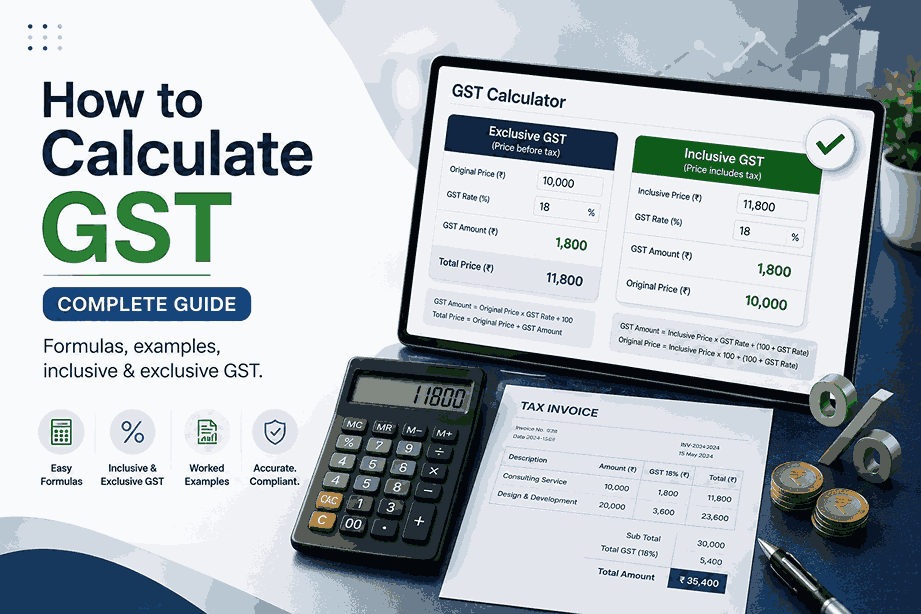
The Goods and Services Tax (GST) is a tax on the supply of goods and services that is based on consumption. Whether you run a business, issue invoices, or shop and want to verify a bill, knowing how to calculate GST helps you price correctly, file accurate returns, and avoid costly mistakes.
This guide covers the basics, the GST formula, inclusive GST and exclusive GST calculations, worked examples, and common mistakes to avoid.
What Is GST?
GST is an indirect tax levied at every stage of the supply chain, from manufacturing and distribution to retail sales and final consumption. Businesses collect it on behalf of the government and can usually claim credit for the GST they paid on their own purchases. The end user is responsible for paying the final tax bill.
Key points about GST:
- The percentage of the value of the goods or services provided is used to calculate this tax.
- Files, images, and data analysis are unavailable until usage resets at 5:44 AM. Continue chatting with text only, or upgrade for more access.
- Try Plus free
- It replaces multiple older indirect taxes with a single, unified system in the countries that use it.
- Rates differ by country and often by product category (for example, essential items may be taxed at lower rates).
- Businesses must show GST clearly on invoices.
Note: GST rates, slabs, and rules vary by country and are updated from time to time. Before preparing invoices or returns, you should always check with your official tax authority to find out the current rate.The percentages used in this article are examples for explanation only.
Why Is It Important to Know How to Calculate GST?
Accurate GST calculation matters for several reasons:
- Correct pricing: You can set selling prices that cover tax and still protect your margin.
- Compliance: Wrong calculations can lead to penalties, notices, or mismatched returns.
- Transparent invoicing: Customers see exactly what they are paying for and how much is tax.
- Honest record-keeping: Accurate accounts build trust with customers, partners, and authorities.
- Better cash flow planning: You know how much tax you hold on behalf of the government.
Understanding the Two Methods: Exclusive and Inclusive GST
Before you use any formula, determine your price.
What Is Exclusive GST?
Exclusive GST indicates that the listed price excludes the applicable GST amount.
- Common in business-to-business (B2B) quotes.
- The final amount is higher than the listed price.
What Is Inclusive GST?
Inclusive GST means the quoted price already includes tax.The amount that is shown has GST added by the seller.
- Common in retail and consumer pricing.
- The final amount is the same as the listed price, but you may need to separate out the tax portion.
| Feature | Exclusive GST | Inclusive GST |
| Listed price | Before tax | After tax |
| GST added on top? | Yes | No, already included |
| Typical use | B2B quotes, estimates | Retail shelf prices |
| Calculation goal | Find total price | Find base price and GST amount |
The GST Formula
There are two sets of formulas, depending on whether the price is exclusive or inclusive.
1. Formula for the GST on the Exclusive Price GST Amount = Original Price × (GST Rate ÷ 100)
The sum of the original price and the amount of tax Oder, in just one step: The total cost is equal to the original cost plus the GST rate of 100. 2. Inclusive price GST formula (removing GST) The GST Amount is equal to [Inclusive Price 100 (100 x the GST Rate)] Original (Base) Price = Inclusive Price × 100 ÷ (100 + GST Rate)
Subtracting the GST percentage from the total is a common error. Because the tax was determined based on the base price rather than the final price, that provides the incorrect response.
How to Calculate Exclusive GST (Step by Step)
Use this method when the price does not yet include tax.
Steps:
- Note the original price (before tax).
- Confirm the applicable GST rate.
- Multiply the original price by the GST rate and divide by 100.
- To get the total, add the GST amount to the original price.
Example 1: Adding GST at 10%
A shop sells a bag of wheat flour for 1,000 (exclusive of GST). The GST rate is 10%.
- GST Amount = 1,000 × 10 ÷ 100 = 100
- Total Price = 1,000 + 100 = 1,100
Example 2: Adding GST at 18%
A web design service is quoted at 25,000 (exclusive of GST). The GST rate is 18%.
- GST Amount = 25,000 × 18 ÷ 100 = 4,500
- Total Price = 25,000 + 4,500 = 29,500
How to Calculate Inclusive GST (Step by Step)
Use this method when the price includes tax and you need to determine the original amount or the tax portion.
Steps:
- Note the total (inclusive) price.
- Confirm the GST rate.
- To determine the base price, divide the total by (100 minus the GST rate) and then multiply by 100.
- Deduct the original price from the total amount to determine the GST component.
Example 3: Removing GST at 10%
A pair of shoes costs 5,500 including 10% GST.
- Base Price = 5,500 × 100 ÷ 110 = 5,000
- GST Amount = 5,500 − 5,000 = 500
Example 4: Removing GST at 18%
An invoice total is 11,800 including 18% GST.
- Base Price = 11,800 × 100 ÷ 118 = 10,000
- GST Amount = 11,800 − 10,000 = 1,800
Shortcut: To find the GST portion directly from an inclusive price, use GST Amount = Inclusive Price × Rate ÷ (100 + Rate).
Example: 11,800 × 18 ÷ 118 = 1,800.
Quick Reference: GST Calculation Table
| Situation | What You Have | What You Want | Formula |
| Exclusive | Base price | GST amount | Base × Rate ÷ 100 |
| Exclusive | Base price | Total price | Base × (1 + Rate ÷ 100) |
| Inclusive | Total price | Base price | Total × 100 ÷ (100 + Rate) |
| Inclusive | Total price | GST amount | Total × Rate ÷ (100 + Rate) |
Calculating GST on Multiple Items
Invoices often include several products with different rates. Calculate GST separately for each line, then add them up.
Example:
| Item | Price (Excl. GST) | Rate | GST Amount | Total |
| Stationery | 2,000 | 10% | 200 | 2,200 |
| Consulting service | 8,000 | 18% | 1,440 | 9,440 |
| Invoice total | 10,000 | 1,640 | 11,640 |
Calculating per item keeps your records accurate and makes return filing much easier.
Understanding Input Tax Credit (ITC) in GST Calculation
Many GST systems let registered businesses reduce their tax payment by the GST already paid on purchases.
Net GST Payable = GST Collected on Sales − GST Paid on Purchases
Example:
- GST collected from customers: 50,000
- GST paid on business purchases: 32,000
- Net GST payable to the government: 18,000
This is why keeping purchase invoices organized is just as important as issuing correct sales invoices. Eligibility conditions apply, so check the rules in your jurisdiction.
Common Mistakes When Calculating GST
Avoid these errors to keep your calculations and filings accurate:
- Subtracting the percentage from an inclusive price. Always use the division method (×100 ÷ (100 + Rate)).
- Using the wrong rate. Different goods and services fall under different slabs.
- Mixing up inclusive and exclusive prices. Always confirm before calculating.
- Rounding too early. Round only at the final step, following local rounding rules.
- Ignoring discounts. GST is normally calculated on the price after trade discounts, as per applicable rules.
- Not matching invoices with returns. Mismatched figures can trigger notices or delays.
- Using outdated rates. Rates change, so check official notifications regularly.
Tips for Accurate GST Calculation
- Keep a current rate chart for the products and services you deal with.
- Use accounting software or a GST calculator to cross-check manual work.
- Clearly mark every price as “inclusive” or “exclusive” on quotes and invoices.
- Maintain organized records of sales and purchase invoices.
- Review your calculations before filing returns.
- For complicated situations, consult a tax professional who is qualified.
Frequently Asked Questions (FAQs)
1. What is the simplest way to calculate GST?
Multiply the base price by the GST rate and divide by 100. Add the result to the base price to get the total.
2. How do I calculate GST from a GST-inclusive price?
Divide the total by (100 + GST rate) and multiply by 100 to get the base price. The difference between the total and the base price is the GST.
3. What is the difference between inclusive and exclusive GST?
With exclusive GST, tax is added to the quoted price. With inclusive GST, the quoted price already contains the tax.
4. Is GST calculated before or after a discount?
In general, GST applies to the discounted transaction value, but rules vary, so check your local regulations.
5. Can I use a single GST rate for all products?
No. Different goods and services can have different rates, so apply the correct rate to each item.
Conclusion
Learning how to calculate GST comes down to knowing whether your price is exclusive or inclusive and applying the right GST formula. For exclusive prices, multiply by the rate and add the result. For inclusive prices, divide by (100 + rate) and multiply by 100 to find the base price and tax portion.
With clear invoices, correct rates, and well-kept records, GST calculation becomes simple and dependable. Honest, accurate accounting also builds trust with your customers and keeps your business in good standing.
Disclaimer: This article does not provide tax or legal advice and is intended solely for educational purposes. Rates and rules differ by country and change over time, so please verify with your official tax authority or a qualified professional.