
Introduction
Every registered taxpayer under the Goods and Services Tax (GST) system has certain compliance responsibilities, and one of the most important is GST return filing. A GST return is an official statement submitted through the GST Portal that contains details of sales, purchases, tax collected, tax paid, and other information required under GST law.
Whether you are a sole proprietor, partnership firm, company, freelancer, or e-commerce seller, understanding how to file GST return correctly helps maintain compliance and avoid unnecessary notices or penalties under applicable GST provisions.
The Government of India has made GST return filing completely online through the official GST Portal. Depending on the type of taxpayer and registration category, different return forms such as GSTR-1, GSTR-3B, and others may apply. Some taxpayers may also need to file a Nil Return if there are no reportable business transactions during a particular tax period.
This comprehensive guide explains everything you need to know about GST return filing, including return types, filing steps, required documents, Nil Returns, common mistakes, and frequently asked questions.
What is GST Return Filing?
GST return filing is the process of submitting GST-related information to the GST authorities through the official GST Portal.
A GST return generally contains:
- Details of outward supplies (sales)
- Details of inward supplies (purchases)
- GST collected
- Input Tax Credit (ITC), where applicable
- Tax payable
- Tax paid
- Other information required under GST rules
The return helps the tax authorities determine a taxpayer’s GST liability.
Why is GST Return Filing Important?
Filing GST returns accurately and on time offers several benefits.
These include:
- Maintaining GST compliance
- Keeping business records updated
- Avoiding late filing consequences
- Supporting eligible Input Tax Credit claims
- Maintaining accurate tax records
- Improving business credibility
Regular return filing is an important part of running a compliant business.
Who Needs to File GST Returns?
Depending on the type of GST registration, returns may be required from:
- Regular taxpayers
- Casual taxable persons
- Composition taxpayers
- Non-resident taxable persons
- Input Service Distributors (ISD)
- E-commerce operators
- OIDAR service providers
The applicable return form depends on the taxpayer’s registration category.
Types of GST Returns
Different taxpayers file different GST returns.
Some common forms include:
GSTR-1
GSTR-1 contains details of outward supplies (sales).
It is generally filed monthly or quarterly depending on the taxpayer’s filing frequency and eligibility.
GSTR-3B
GSTR-3B is a summary return used to declare tax liability and complete payment obligations.
It is one of the most commonly filed GST returns.
GSTR-4
This return applies to eligible taxpayers registered under the Composition Scheme.
Other GST Returns
Depending on the nature of registration, taxpayers may also file other prescribed returns such as GSTR-5, GSTR-5A, GSTR-6, GSTR-7, GSTR-8, GSTR-9, and others where applicable.
What is GSTR Filing?
GSTR filing refers to submitting the applicable GST Return Forms through the GST Portal.
Each return has a specific purpose and reporting requirement.
Examples include:
- Reporting outward supplies
- Declaring tax liability
- Reporting purchases
- Annual reconciliation
- Special category taxpayer reporting
Selecting the correct return is essential for GST compliance.
Documents Required Before Filing GST Returns
Before starting the filing process, keep the following information ready.
- GSTIN
- GST Portal login credentials
- Sales invoices
- Purchase invoices
- Credit notes
- Debit notes
- Tax payment details
- Bank information (where required)
- Previous return details
Maintaining organized records helps reduce filing errors.
How to File GST Return
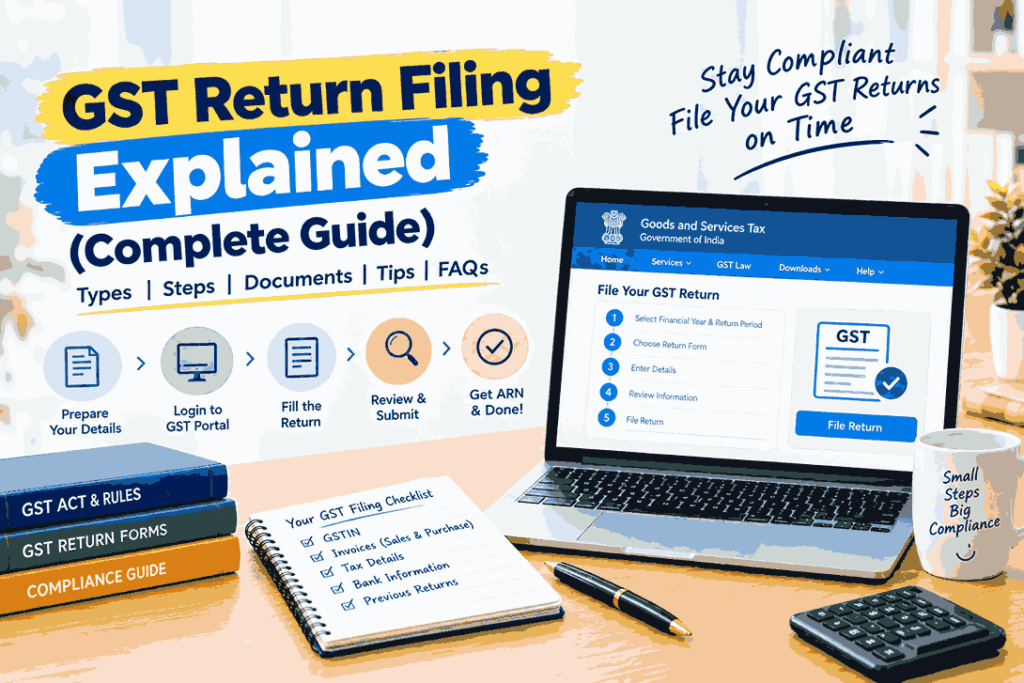
The process for file GST return is completed online.
Step 1: Log in to the GST Portal
Visit the official GST Portal.
Enter:
- Username
- Password
- CAPTCHA
After successful login, your dashboard will open.
Step 2: Open Returns Dashboard
Navigate to:
Services → Returns → Returns Dashboard
Select:
- Financial Year
- Return Period
Then click Search.
Step 3: Choose the Applicable Return
Depending on your registration, select the required return such as:
- GSTR-1
- GSTR-3B
- GSTR-4
- Other applicable return
Step 4: Enter Required Information
Provide the required information such as:
- Sales details
- Purchase details
- Tax liability
- Eligible Input Tax Credit
- Other required information
Some details may already be auto-populated based on previously filed returns or system-generated data.
Step 5: Review the Return
Before submission:
- Verify invoices.
- Check tax calculations.
- Review GSTIN details.
- Confirm all information is accurate.
Careful review helps prevent filing errors.
Step 6: Submit the Return
After verification:
- Select the declaration.
- Choose the authorized signatory.
- File using either:
- Digital Signature Certificate (DSC), where applicable
- Electronic Verification Code (EVC)
Upon successful filing, an Acknowledgement Reference Number (ARN) is generated.
What is a Nil Return?
A Nil Return is filed when there are no reportable transactions during the tax period and the taxpayer meets the conditions specified for filing a Nil return.
For example, a Nil GSTR-3B may be filed only when there are no outward supplies, no eligible inward supplies generating liability, no Input Tax Credit to claim, and no outstanding liabilities for that period.
When Should You File a Nil Return?
You may need to file a Nil Return if:
- No sales were made.
- No taxable purchases created liability.
- No GST liability exists for the period.
- The applicable conditions for Nil filing are satisfied.
Even if there is no business activity, certain taxpayers are still required to file the applicable return.
Benefits of Filing GST Returns on Time
Timely filing offers several advantages.
For Businesses
- Better compliance
- Updated GST records
- Improved business credibility
- Easier financial management
- Reduced risk of notices for non-filing
For Accountants
- Better reconciliation
- Organized documentation
- Accurate reporting
- Easier audit preparation
For Customers
Timely GST compliance contributes to smoother business transactions and accurate invoicing.
Common Mistakes During GST Return Filing
Avoid these common errors.
- Incorrect GSTIN
- Missing invoices
- Wrong tax calculations
- Incorrect return selection
- Duplicate entries
- Delayed filing
- Ignoring portal notifications
- Not reviewing the return before submission
Checking your data carefully can reduce filing issues.
Tips for Accurate GSTR Filing
Follow these best practices.
- Maintain organized accounting records.
- Match invoices before filing.
- Review all entries carefully.
- File returns before the due date.
- Save acknowledgment receipts.
- Keep copies of filed returns.
- Regularly reconcile sales and purchase records.
Frequently Asked Questions (FAQs)
What is GST return filing?
GST return filing is the process of submitting GST-related information through the GST Portal for the applicable tax period.
How can I file GST return?
You can file GST return online through the official GST Portal by logging in, selecting the applicable return, entering the required information, reviewing the details, and filing using DSC or EVC.
What is GSTR filing?
GSTR filing refers to submitting the prescribed GST return forms, such as GSTR-1 or GSTR-3B, through the GST Portal.
What is a Nil Return?
A Nil Return is a GST return filed when the taxpayer satisfies the prescribed conditions for having no reportable transactions or tax liability during the relevant tax period.
Can I file a GST return without logging in?
No. Filing GST returns requires logging into the official GST Portal using valid taxpayer credentials.
What happens after filing a GST return?
After successful filing:
- An Acknowledgement Reference Number (ARN) is generated.
- The return status changes to Filed.
- A confirmation is sent to the registered contact details.
Best Practices for GST Compliance
To ensure smooth GST compliance:
- File every applicable return on time.
- Maintain accurate accounting records.
- Verify invoices before submission.
- Preserve acknowledgment receipts.
- Reconcile business records regularly.
- Use only the official GST Portal for return filing.
- Monitor portal notifications for updates or notices.
Conclusion
Understanding GST return filing is essential for every registered taxpayer. Filing accurate returns helps businesses maintain compliance, keep financial records organized, and fulfill their obligations under the GST system.
Whether you need to file GST return, complete GSTR filing, or submit a Nil Return, following the correct process through the official GST Portal makes compliance easier and more efficient. Preparing accurate records, selecting the appropriate return form, and reviewing all details before submission can significantly reduce errors and delays.
By making GST return filing a regular part of your business operations, you can ensure smoother compliance, maintain reliable financial records, and confidently meet your GST responsibilities.