
Introduction
Cement is the backbone of construction, from a family home to a bridge or highway. When the tax on cement changes, builders, contractors, dealers, and homeowners all feel it in their budgets. That is why “cement GST rate” is one of the most searched construction-related tax terms.
For years, cement was taxed at the highest GST slab. A major reform changed that. This guide explains the current cement GST rate, the HSN code, how to calculate the tax on a purchase, how input tax credit applies, and how to avoid common billing mistakes.
What Is the Current GST Rate on Cement?
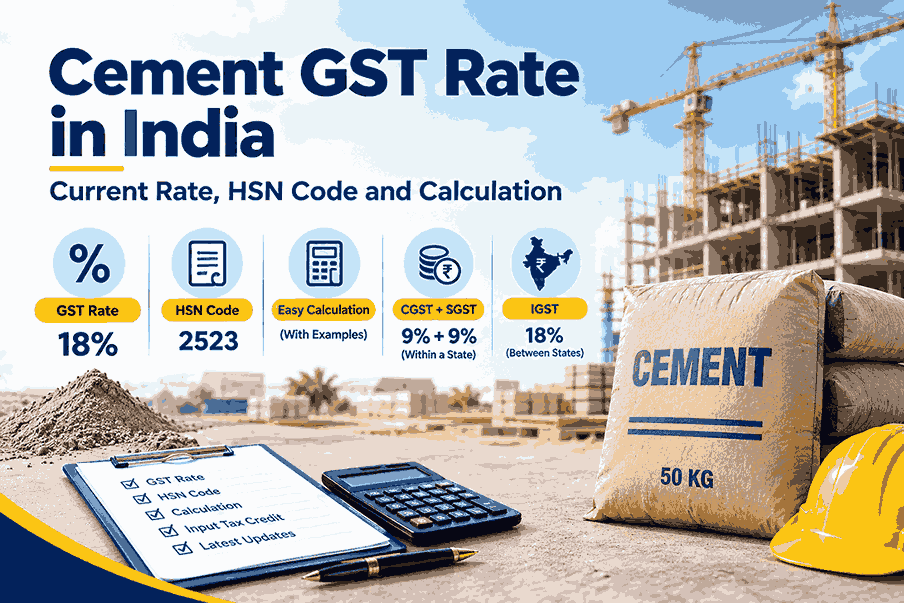
The applicable GST rate on cement is currently 18%. This applies to all major types of cement, whether sold in standard bags or in bulk, including:
- Ordinary Portland Cement (OPC)
- Portland Pozzolana Cement (PPC)
- Slag cement
- White cement
- Other hydraulic cements
- Cement clinker
The rate came into effect on 22 September 2025, and it applies uniformly across these varieties.
Cement GST Rate History: From 28% to 18%
| Period | GST Rate on Cement |
| From GST launch (2017) to 21 September 2025 | 28% |
| From 22 September 2025 onwards | 18% |
Cement remained in the 28% slab for a long time, which made it one of the costliest items in the construction supply chain. The reduction was part of a broader GST reform that simplified the rate structure and moved many construction inputs into lower slabs.
HSN Code for Cement
Every product under GST is classified by an HSN (Harmonised System of Nomenclature) code. For cement:
- In addition to cement clinker, HSN 2523 includes hydraulic cements like Portland cement, aluminous cement, slag cement, and super sulphate cement.
- Ready-mix concrete and some cement-based products fall under different HSN codes, so always check the code and rate for the exact product.
Using the correct HSN code on invoices matters because it determines the rate and keeps your returns accurate.
Cement GST Rate by Type
| Cement Type | HSN Code | GST Rate |
| OPC | 2523 | 18% |
| PPC | 2523 | 18% |
| Slag cement | 2523 | 18% |
| White cement | 2523 | 18% |
| Cement clinker | 2523 | 18% |
The rate does not change with the brand, grade, or bag size.
How to Calculate GST on Cement
Adding GST to a Base Price
- GST Amount = Base Price × 18 ÷ 100
- Total Price = Base Price + GST Amount
Example 1: Buying Cement Bags
Prices are illustrative.
A contractor buys 100 bags of cement at a base price of ₹300 per bag.
- Base value = 100 × ₹300 = ₹30,000
- GST at 18% = ₹5,400
- Total payable = ₹35,400
Example 2: Comparison With the Old Rate
On the same purchase at the old 28% rate:
- GST at 28% = ₹8,400
- Total payable = ₹38,400
| Rate | GST Amount | Total |
| 28% (old) | ₹8,400 | ₹38,400 |
| 18% (current) | ₹5,400 | ₹35,400 |
| Difference | ₹3,000 | ₹3,000 |
Keep in mind that the final retail price is influenced by factors such as market conditions, the manufacturer, and the dealer, so any price reduction may not be reflected immediately in the amount paid by consumers.
Removing GST from an All-Inclusive Price is an example 3.
If an invoice total is ₹11,800 including 18% GST:
- Base Price = 11,800 × 100 ÷ 118 = ₹10,000
- GST Amount = 11,800 − 10,000 = ₹1,800
CGST, SGST, and IGST on Cement
The 18% is split depending on where the supply takes place.
| Type of Supply | Tax Charged | Split at 18% |
| Within the same state | CGST + SGST | 9% + 9% |
| Between two states | IGST | 18% |
| Within a Union Territory without a legislature | CGST + UTGST | 9% + 9% |
Your dealer’s invoice should show the correct split based on the location of supply.
Input Tax Credit (ITC) on Cement
Whether you can claim credit for the 18% GST depends on who you are and how you use the cement.
When ITC Is Generally Available
- Businesses that are registered to use cement and have taxable supplies, subject to the conditions of Section 16 of the CGST Act
- Manufacturers of cement products who buy cement as an input
- Dealers who buy cement for resale
When ITC May Not Be Available
- A homeowner who is not registered under GST
- Cement used to construct an immovable property for your own use, in many cases, because of the blocked-credit rules
- Situations where a particular scheme or rate structure does not allow input credit
Because ITC rules for construction can be complex, confirm your position with a qualified tax professional before claiming credit.
Who Is Affected by the Cement GST Rate?
- Homeowners and individual builders: The tax is part of the cost of building and cannot usually be recovered.
- Contractors and builders: Cement is a major input, so the rate affects project cost and quotations.
- Dealers and distributors: They collect GST on sales and may claim input credit on purchases.
- Cement manufacturers: They charge GST on sales and may claim credit on eligible inputs.
- Infrastructure companies: Large projects feel the rate through material costs.
How the Rate Cut Affects Construction Costs
A lower tax rate can reduce the cost of materials and, over time, the cost of construction. Some practical points:
- The saving depends on how much of the tax cut is passed on in the selling price.
- Cement is one of several inputs, so total project cost falls only partly.
- Contractors with fixed-price contracts signed earlier should review how the rate change affects their agreements.
- Buyers should compare current quotations with older ones to confirm the new rate is applied.
What About Other Construction Materials?
Cement is only one item on a building site. Bricks, sand, steel, tiles, paints, and fittings all have their own HSN codes and GST rates, and some were revised in the same reform. Never assume a material shares cement’s rate. Check each item’s classification and the current rate schedule.
Invoice Requirements for Cement Sales
A valid tax invoice for cement should show:
- Supplier’s name, address, and GSTIN
- Invoice number and date
- Buyer’s details (GSTIN for registered buyers)
- Description of goods and the HSN code (2523)
- Quantity and unit price
- Taxable value
- CGST/SGST or IGST rate and amount
- Total invoice value
For transporting goods above the prescribed value limit, an e-way bill may also be required. Check the current threshold and rules on the official portal.
Common Mistakes Related to Cement GST
- Using the outdated 28% rate on quotations and invoices
- Applying the cement rate to other materials such as bricks, sand, or steel
- Forgetting to show the HSN code on the invoice
- Claiming ITC on cement used for blocked purposes
- Using IGST in place of CGST/SGST for supplies between states
- Comparing prices without checking whether GST is included
- Relying on unofficial websites without confirming on the GST portal
Tips for Buyers and Businesses
- Verify that the HSN code and 18% GST are displayed on your invoice.
- Ask whether a quoted price is inclusive or exclusive of GST.
- Compare the final payable amount from multiple dealers.
- Keep invoices safe for your records and any claims.
- Review old contracts and estimates after the rate change.
- Check the latest GST Council notifications regularly.
- Be transparent and accurate in all billing. Honest dealing builds trust between buyers and sellers.
Frequently Asked Questions (FAQs)
1. What is the GST rate on cement?
The GST rate on cement is 18%.
2. What was the earlier GST rate on cement?
It was 28% until 21 September 2025.
3. When did the new cement GST rate start?
It took effect on 22 September 2025.
4. What is the HSN code for cement?
HSN 2523 covers most types of cement and cement clinker.
5. Is GST the same for OPC, PPC, and white cement?
Yes, they are all taxed at 18%.
6. Is GST charged on cement bags and bulk cement equally?
Yes. The rate applies regardless of packaging.
7. Can a homeowner claim ITC on cement?
Generally no. Input credit is for registered businesses using goods for taxable business supplies, subject to the law.
8. How is GST split on cement within a state?
It is divided into 9% CGST and 9% SGST.
9. Does the lower rate guarantee a lower price?
Not automatically. Market prices depend on manufacturers and dealers, though the tax component is lower.
Conclusion
The cement GST rate is 18% under HSN 2523, down from 28% since 22 September 2025. The rate applies to all major types of cement, and it is split into CGST and SGST within a state or charged as IGST between states. Registered businesses may claim input credit where the law allows, while homeowners treat the tax as part of their building cost.
By using the correct rate and HSN code, checking invoices carefully, and keeping records, buyers and sellers can avoid errors and disputes. Because GST rates can be revised, always confirm the current rate on the official GST portal before billing or budgeting.
Disclaimer: This article is for general information only and is not legal or tax advice. Examples are illustrative, and rates may change. Please verify with official sources or a qualified professional.