
Introduction
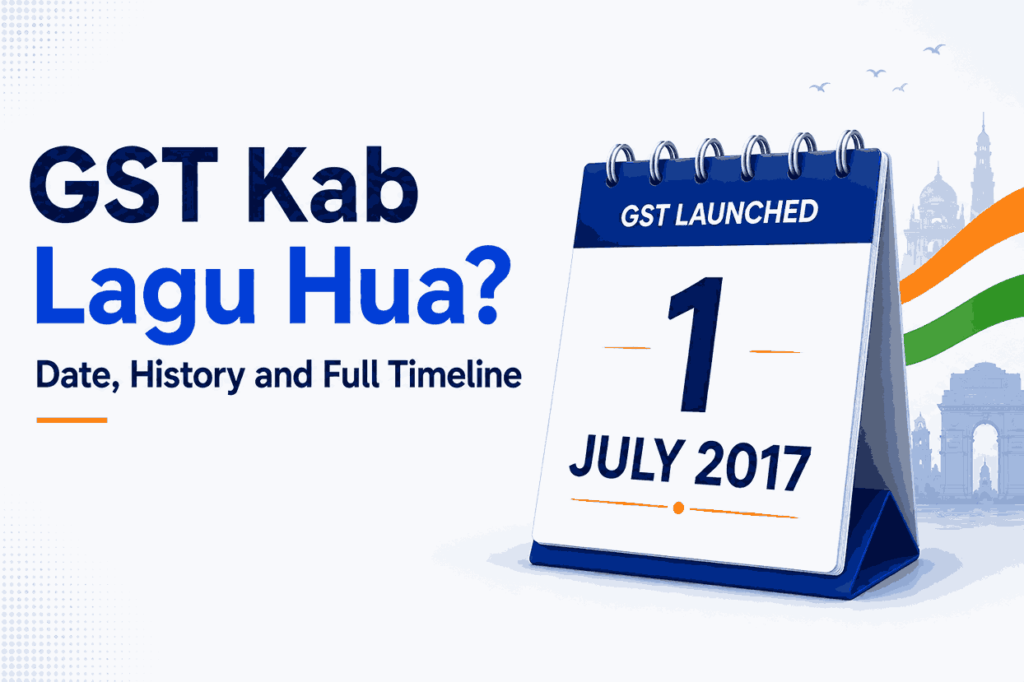
Almost every student, taxpayer, and business owner has wondered at some point: GST kab lagu hua? The short answer is that GST came into force in India on 1 July 2017. But the story behind that date is long, and it includes years of debate between the Centre and the states, a constitutional amendment, and a midnight launch.
This guide explains when GST was implemented, how India reached that point, what GST replaced, what changed after launch, and how the system has evolved up to the major 2025 reforms.
GST Kab Lagu Hua? The Short Answer
India introduced the Goods and Services Tax (GST) on 1 July 2017.
सरल हिंदी में: GST 1 जुलाई 2017 को पूरे भारत में लागू किया गया था।
In Hinglish: GST 1 July 2017 se lagu hua.
Key facts at a glance:
| Question | Answer |
| Date GST was launched | 1 July 2017 |
| Date for Jammu and Kashmir | 8 July 2017 |
| Constitutional amendment | 101st Amendment Act, 2016 |
| Amendment notified | 8 September 2016 |
| Governing body | GST Council |
| Nature of tax | Indirect tax on goods and services |
The Midnight Launch
GST was rolled out in a special ceremony at midnight, marking the shift from the old tax system to the new one. The date was chosen after the GST Council and the states agreed on readiness, and it meant that from 1 July 2017, most indirect taxes on goods and services were replaced by a single, unified system.
Jammu and Kashmir: A Week Later
Jammu and Kashmir joined the GST system a little later, on July 8, 2017, due to special constitutional provisions in effect at the time.
The steps were:
- The President gave assent to an order extending the 101st Amendment to the state.
- The state legislature passed its own GST law.
- Introduced the IGST mechanism for transactions involving trade between different states.
From 8 July 2017, GST applied across the whole country, completing the idea of “one nation, one tax.”
The Long Journey to GST: Timeline
GST did not appear overnight. It took well over a decade of discussion, and several deadlines were missed before the final launch.
| Year | Milestone |
| 2006 | The Union Budget for 2006-07 announces GST, aiming for implementation from 1 April 2010 |
| 2009 | The Empowered Committee of State Finance Ministers releases its first discussion paper |
| 2011 | The Constitution (115th Amendment) Bill is introduced, but later lapses |
| 2014 | The Constitution (122nd Amendment) Bill is introduced in the Lok Sabha |
| August 2016 | Parliament passes the amendment, and states begin ratifying it |
| 8 September 2016 | The Constitution (101st Amendment) Act, 2016 is notified |
| September 2016 | The GST Council holds its first meeting |
| March 2017 | The GST Council recommends the central, state, integrated, and union territory GST laws |
| 1 July 2017 | GST is launched |
| 8 July 2017 | Jammu and Kashmir joins |
The original target of April 2010 was missed, mainly because the Centre and the states had to agree on how tax powers and revenue would be shared.
Why Did It Take So Long?
GST needed more than a new law. It needed the Constitution itself to be amended, because tax powers were divided between the Centre and the states.
The main challenges were:
- Sharing of tax powers: States were cautious about giving up their own taxing rights.
- Revenue concerns: States wanted assurance against revenue losses.
- Political consensus: The amendment needed support in Parliament and ratification by at least half of the state legislatures.
- Technology: A national online system had to be built to handle registration, returns, and payments.
- Readiness of businesses: Millions of taxpayers needed time to prepare.
The Role of the 101st Constitutional Amendment
The Constitution (101st Amendment) Act, 2016 was the legal foundation of GST. It:
- Gave both the Centre and the states concurrent power to tax goods and services
- Created the GST Council under Article 279A
- Allowed the Council to recommend rates, exemptions, thresholds, and rules
- Introduced the concept of IGST for trade between states
Assam was among the first states to ratify the amendment in August 2016, and other states followed.
The GST Council
The GST Council is the joint forum of the Union Finance Minister, the Union Minister of State for Finance, and the finance ministers of all the states. It decides:
- GST rates and slabs
- Exemptions and thresholds
- Model GST laws and rules
- Special provisions for certain states
Its decisions are taken through consensus-based voting, with the Centre and states each holding a defined share of votes.
Which Taxes Did GST Replace?
Before GST, India had many separate indirect taxes. GST subsumed several of them:
Central taxes replaced:
- Central Excise Duty
- Service Tax
- Central Sales Tax (CST)
- Additional Customs Duty (CVD and SAD)
State taxes replaced:
- Value Added Tax (VAT)
- Entry Tax
- Entertainment Tax
- Luxury Tax
- Octroi
- Purchase Tax
Some items, such as certain petroleum products, remained outside GST, and customs duty on imports continues separately.
What Did the GST System Look Like at Launch?
At launch in July 2017, the GST structure included:
- Four main taxes: CGST, SGST, IGST, and UTGST
- A multi-slab rate structure: 0%, 5%, 12%, 18%, and 28%, with a compensation cess on certain goods
- GSTIN: A unique registration number for every registered taxpayer
- An online GST portal: For registration, returns, and payments
- To avoid paying tax, use the input tax credit.
- A composition scheme: A simplified option for small taxpayers
Early Challenges After Launch
The first months were a learning period. Common difficulties included:
- Getting used to the GST portal and new return forms
- Understanding classification and rates
- Frequent changes to deadlines and rules
- Matching invoices and claiming input credit
- Adjusting software and accounting practices
Over time, the system was refined with simpler return filing, improved processes, and clearer guidance.
Key Milestones After 2017
| Period | Development |
| 2017 | GST launched, with the GST portal live for registration and returns |
| 2017 to 2018 | A simplified summary return (GSTR-3B) and further relaxations introduced |
| 2018 | E-way bill system rolled out for movement of goods |
| 2018 onwards | Rate reductions on many items following Council meetings |
| 2020 onwards | Gradual process reforms and compliance improvements |
| September 2025 | The next-generation reforms (“GST 2.0”) simplify the rate structure into 5% and 18% main slabs plus a special 40% rate |
You can read more about these changes in our guide on next-gen GST reforms.
GST Day
India observes 1 July each year as GST Day to mark the anniversary of the launch. The occasion is used to reflect on how far the system has come and what can be improved.
Why Was GST Introduced?
GST was designed to:
- Replace many indirect taxes with one system
- Reduce the cascading effect (tax on tax)
- Create a common national market
- Simplify compliance for businesses
- Improve transparency and tax administration
- Support ease of doing business
Benefits Seen Since GST Began
For Businesses
- One registration and one return framework instead of many
- Input Tax Credit across the supply chain
- Smoother movement of goods between states
- Online processes
For Consumers
- More transparent invoices
- Reduced hidden taxes in prices
- Lower rates on many items after later reforms
For the Government
- A broader tax base
- Better tracking through digital records
- Higher compliance over time
Important Points for Students and Exam Preparation
- GST launch date: 1 July 2017
- J&K implementation: 8 July 2017
- Amendment Act: Constitution (101st Amendment) Act, 2016
- Article for GST Council: Article 279A
- First proposed in a budget: 2006-07 Union Budget
- Original target date missed: 1 April 2010
- Four components: CGST, SGST, IGST, UTGST
- GST Day: 1 July
Common Misconceptions About the Start of GST
“GST was launched in 2016.”
No. The constitutional amendment was passed in 2016, but GST itself started on 1 July 2017.
“GST started on 1 April 2017.”
No. The financial year began on 1 April, but GST was launched on 1 July.
“GST was the first indirect tax reform in India.”
No. Earlier reforms, such as VAT and Modvat, preceded it, but GST was the largest.
“Every state joined on the same day.”
Almost all did on 1 July 2017, but Jammu and Kashmir joined on 8 July 2017.
Frequently Asked Questions (FAQs)
1. GST kab lagu hua?
GST was implemented on 1 July 2017.
2. GST kis date ko shuru hua?
It started on 1 July 2017, at midnight.
3. When was GST implemented in Jammu and Kashmir?
On 8 July 2017.
4. Which amendment introduced GST?
The Constitution (101st Amendment) Act, 2016.
5. When was GST first announced?
In the Union Budget for 2006-07, with a target of April 2010.
6. What is GST Day?
1 July, observed to mark the anniversary of GST.
7. Which taxes did GST replace?
Central taxes such as excise duty and service tax, and state taxes such as VAT, entry tax, and octroi.
8. Has the GST structure changed since 2017?
Yes. Rates, rules, and processes have been revised many times, including major reforms in September 2025.
Conclusion
So, GST kab lagu hua? The answer is 1 July 2017, with Jammu and Kashmir joining on 8 July 2017. Behind that date lies a decade-long journey: a budget announcement in 2006, missed deadlines, the 101st Constitutional Amendment in 2016, and the formation of the GST Council that finally brought the Centre and states together.
Since launch, GST has been refined many times, culminating in the simplified structure introduced in 2025. For students, taxpayers, and business owners alike, knowing this history makes it easier to understand why the system looks the way it does today. Because rules and rates continue to evolve, always check the official GST portal for the latest updates.
Disclaimer: This article is for general information only and is not legal or tax advice. Please verify details with official government sources.